A Drop of Corruption
A Drop of Corruption - Full Book Summary and Recap
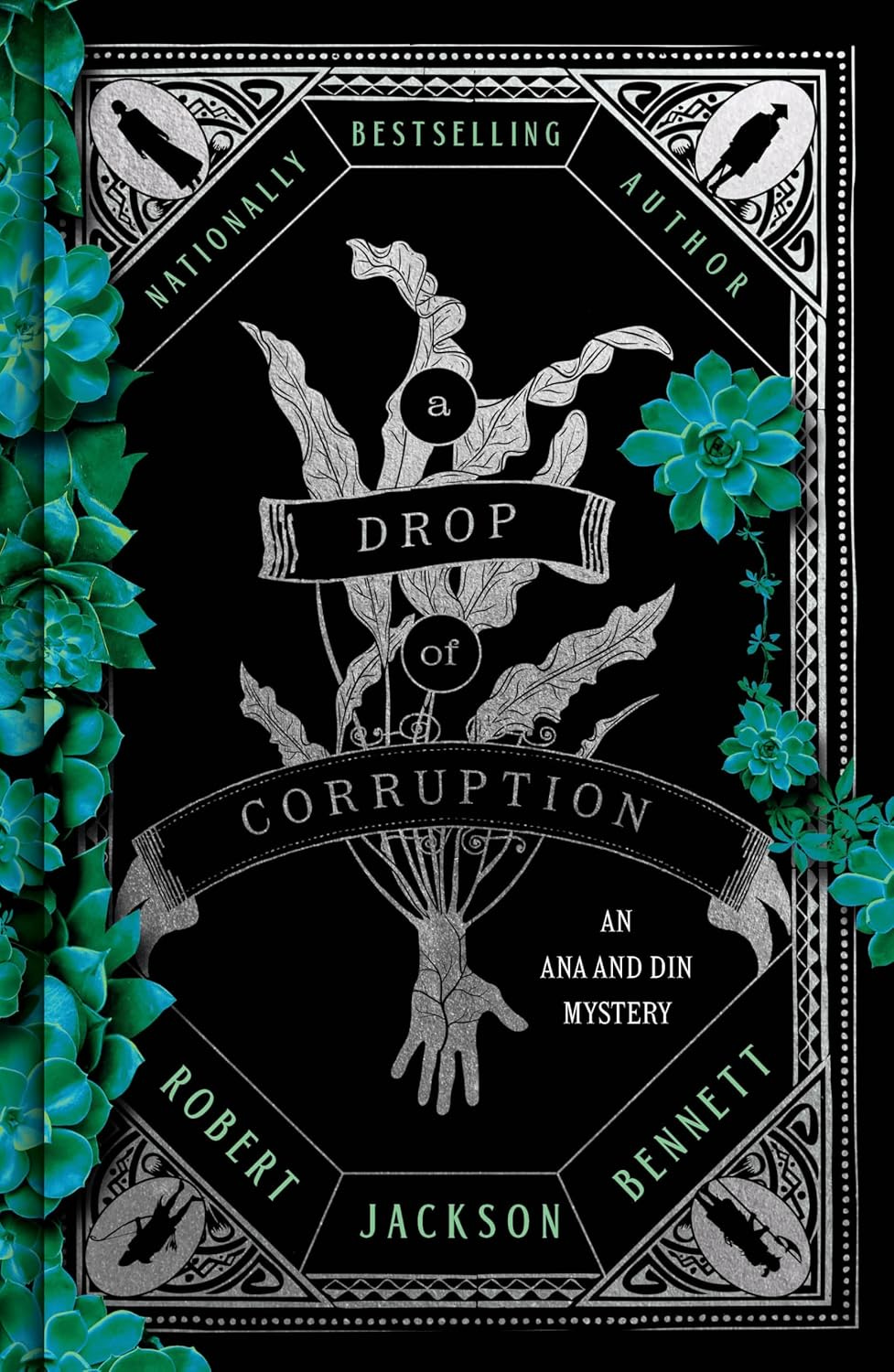
Hey Fantasy Fanatics! Blogger extraordinare here, ready to dive headfirst into the murky, bio-luminescent depths of Robert Jackson Bennett’s A Drop of Corruption! If you read The Tainted Cup , you know Bennett is crafting something seriously unique with his Ana and Din mysteries – part Sherlock Holmes, part creature feature, all wrapped up in a world brimming with biological wonders and horrors. A Drop of Corruption takes everything from the first book and dials it up, adding layers of political intrigue, body horror, and mind-bending reveals. Grab your wariest nose and sharpest eyes, because we’re heading back into the Empire of Khanum!
_ MASSIVE SPOILER WARNING: Seriously, I’m recapping the whole thing. Plot points, twists, the ending – everything. If you haven’t read it yet, proceed with extreme caution (or maybe just bookmark this for later!)._
Plot Synopsis: Unraveling the Impossible
Our story kicks off with our favorite Iudex investigator assistant, Dinios Kol (Din), arriving in the steamy, oppressive northern port town of Yarrowdale. This isn’t quite Empire proper; it’s a vital tribute state, crucial for processing leviathan materials but politically… complicated. Din’s here to investigate the disappearance and presumed death of Immunis Mineti Sujedo, a Treasury official. He’s met not by a polished imperial officer, but by Signum Tira Malo, a local Apoth warden, mud-caked, blunt, and possessing unsettlingly augmented senses (and a penchant for predicting Din’s digestive distress ).
The mystery starts weird and gets weirder. Sujedo vanished from inside his locked room, high up in a leaning, dilapidated tower in Old Town Yarrowdale. The only signs of foul play were a struggle and a significant bloodstain on his bed. Stranger still, his remains – specifically, a severed hand, a chunk of torso (missing organs), and a jawbone – were found days later, twelve leagues away in the canals, seemingly nibbled on by local carnivorous turtles called reaper-backs. Malo, who leads the initial investigation, is stumped. How did Sujedo disappear? How did the attacker get in and out unseen? How did the remains end up so far away?
Din, using his enhanced memory (an engraver, he forgets nothing), meticulously examines the scene and the remains back at the Yarrowdale Apoth ossuary. The remains are preserved in “ossuary moss,” a predatory fungus altered by the Apoths to preserve tissue instead of consuming it. The examination is grim: the body parts were clearly cut before entering the water, suggesting the reaper-backs were used for disposal, not the cause of death. The hand shows signs of being bound with tar-soaked canal rope. There’s also a strange circular patch of skin missing from the shoulder blade, and an odd, small, smooth piece of iron (lodestone!) found on the floor of Sujedo’s room. The only other oddity? Sujedo’s clothes reeked of citrus and mold, perhaps to mask scents.
Interviews with the tower staff reveal little, except that Sujedo seemed ill, kept to himself, and had a strange habit of tapping his fingers or leg rhythmically. The guard who escorted Sujedo noted his uncanny (for an axiom, a type of Sublime focused on calculation) ability to deduce personal details, like the guard’s recent marriage.
Din reports his findings to his commanding officer, the eccentric genius Immunis Ana Dolabra, who arrives in Yarrowdale amidst a self-created mountain of oyster shells . Ana, often blindfolded to manage her overwhelming sensory input and unique cognitive alterations, immediately sinks her teeth into the paradoxes. She dismisses simple assassination – too many easier ways. The complexity suggests something more. She focuses on inconsistencies: the guard reported Sujedo asked astute personal questions (unlike a typical axiom) and tapped rhythmically; another engraver at the Treasury bank described Sujedo as being significantly taller than Gorthaus (Kardas’s assistant engraver) remembered him being years ago.
Ana’s brilliant deduction: The man who arrived in Yarrowdale, checked into the rooms, visited the bank, and then “vanished” was not Sujedo at all. He was an impostor.
-
The Setup: Real Sujedo was kidnapped en route to Yarrowdale. His blood, urine, clothes, and documents were taken.
-
The Impostor: An unknown figure, disguised using Sujedo’s effects and possibly minor flesh-shaping, took his place. He visited the bank, crucially accessing Sujedo’s secure vault box alone.
-
The Disappearance: The impostor faked the abduction scene using Sujedo’s blood/urine, then escaped the locked room. Ana theorizes he used the lodestone Din found to manipulate the iron window lock from the outside, climbed down one level to an adjacent vacant room (bypassing the guarded hallway door), sawed through that room’s lock, and slipped away.
-
The Disposal: Days later, the real Sujedo was murdered, dismembered, and fed to the reaper-backs to create the misleading crime scene Malo found.
The motive? Accessing Sujedo’s Apoth vault box at the Treasury bank. But what was inside? Prificto Kardas, the head of the Treasury delegation, reveals the box contained sensitive papers regarding Yarrow’s impending formal adoption into the Empire and tax projections. But Ana presses further, recalling the specific type of box – it wasn’t a standard Treasury box, but a high-security Apoth box.
This leads them to Immunis Rava Ghrelin, the Apoth official who last made a deposit in that specific box. Ghrelin, a nervous, meticulous man, claims the box contained formulas and reagents for advanced healing grafts targeting respiratory illnesses. He also reveals a past working inside the Shroud, the mysterious, living structure in the bay where leviathan blood is processed. He exhibits the same rhythmic tapping Din noted about the impostor. When confronted, he admits the box didn’t contain healing grafts, but papers and reagents related to the Shroud’s deepest secret: the successful extraction and stabilization of leviathan marrow.
Suddenly, the impostor places a severed head inside Ghrelin’s Apoth box. The head belongs to Princeps Traukta Kaukole, an Apoth officer who disappeared two years prior, presumed killed by smugglers. Tucked into the head’s mouth is a note: “For those who sip from the marrow / Te siz imperiya.” The last part is an inversion of the imperial motto “Sen sez imperiya” (You are the Empire), twisting it to “I am the Empire.”
Ana now believes the impostor, whom she identifies as Sunus Pyktis (a brilliant augur presumed dead in a Shroud disaster years ago), is an Apoth himself, possibly one given access to Ghrelin’s box previously. He’s also likely connected to the marrow project. The tapping is revealed to be an obscure monastic code language used by some augurs within the Shroud due to the mental strain of normal conversation under augury’s influence. Ghrelin, trained in it, unconsciously uses it under stress. Pyktis clearly does too.
The investigation shifts focus. What exactly is the marrow project? Thelenai and Ghrelin confess: it’s a top-secret, unsanctioned attempt to extract and cultivate leviathan marrow, hoping to create a stable, transportable source of the kani (titan’s blood), rendering the dangerous Shroud and Yarrowdale itself obsolete. This would allow the Empire to potentially withdraw from Yarrow, abandoning its century-old promise of adoption – a plan Kardas was secretly negotiating with Satrap Darhi, betraying both the Empire and Yarrow. They also reveal the existence of “augury,” a temporary graft enhancing an axiom’s predictive and analytical abilities to godlike levels, but with severe side effects like paranoia and apophenia (seeing patterns everywhere) after prolonged use. Pyktis was one of the original, most brilliant augurs.
Pyktis’s motive becomes clearer: not just theft, but sabotage. He wants to destroy the marrow, likely seeing the project and the Empire’s control as a corruption. Ana realizes Pyktis has been playing them, leaving clues, anticipating their moves. His escape from the Shroud was faked; the “accident” that supposedly killed him was likely his own doing, perhaps an attempt to destroy the Shroud even then.
The hunt shifts to finding Pyktis and, more importantly, the six crates of stolen, highly concentrated kani fertilizer he apparently stole months ago – enough to potentially create a devastating biological weapon. They raid the smuggler camp where Sujedo’s remains were found. Instead of smugglers, they find a horrifying scene: the entire camp and its inhabitants have been transmuted by kani exposure into grotesque plant/flesh hybrids – a “savage garden.” In the center sits a complex “degradation diffuser,” an Apoth device apparently built by Pyktis to weaponize the stolen kani fertilizer. Before it hangs a sign made of hide, covered in bizarre symbols (another code?) and the words: “And all the world a savage garden, mindless and raging” – a quote attributed to Emperor Daavir warning against unchecked human passions.
They discover the body of the impostor from the bank – Pyktis – dead in a chest among Darhi’s stolen treasure at a remote estate. He has dozens of blotley welt marks on his torso. Ana reveals the final piece: blotley larvae can absorb blood rights. Pyktis used them on Sujedo to gain Treasury vault access. The welts are the proof. But how did Darhi get Pyktis’s body? And who killed Pyktis?
The shocking climax arrives in the High City. The King of Yarrow is dead, poisoned. Kardas is also poisoned but survives. Pavitar blames Kardas. Ana, however, reveals Pyktis is Prince Camak’s identical twin brother, hidden away at birth and raised as a Rathras Apoth, groomed by his father for the secret mission to destroy the Shroud. Pyktis, pretending to be Prince Camak, killed the king and poisoned Kardas (via thumb-biting after handling the cup). He then used his augury-enhanced mimicry to perfectly impersonate the prince. Ana exposes him by playing a specific irritating rhythm on her lyres that only an augur would react to. Cornered, Pyktis is slain not by imperials, but by Jari Pavitar, horrified by the revelation of this secret heir and the sacrilege committed.
The Ending: With Pyktis dead and the immediate threat over, the political situation is a mess. Yarrow is collapsing, naukari are fleeing. Kardas is disgraced. Thelenai turns herself in for the unauthorized marrow project. Ana arranges for the suspension of Din’s debts and offers him her recommendation for the Legion, but Din chooses to stay with the Iudex, understanding its unique importance. Ana reveals her final secret: she is likely one of the ancient Khanum race, remade or reborn, hinting at her own strange abilities and motivations. As the book closes, Ana prepares for a medically induced sleep to recover, while Din watches the massive hydricyst ship arrive to transport the now-secured leviathan marrow, pondering the future and Ana’s true nature. Malo is potentially being transferred to Ashradel under a different investigator, leaving Yarrow behind.
Character Analysis: Minds and Monsters
Robert Jackson Bennett excels at character, and this book is no exception.
-
Dinios Kol (Din): Our viewpoint character remains the heart of the story. He’s meticulous, duty-bound, and burdened by his perfect memory and his family’s debts. His journey here is less about solving the case (Ana does the heavy lifting) and more about confronting the nature of the Empire, justice, and his own desires. His decision to stay with the Iudex, choosing the difficult path of “managing the stain” over the perceived glory of the Legion, marks significant growth. His relationship with Ana deepens, moving from professional respect to a complex, wary understanding.
-
Ana Dolabra: Oh, Ana. She remains an enigma wrapped in brilliance and eccentricity. Her deductions are stunning, but A Drop of Corruption peels back layers to reveal why. Her sensory issues, her unique cognitive processes, her flashes of deep, resonant voice, her intimate knowledge of obscure imperial history and even physiology… all culminate in the earth-shattering hint that she might be a remade Khanum. This reframes everything about her – her power, her detachment, her interest in specific cases. Is she manipulating events? Is her goal truly justice, or something older? Her feast scene is both horrifying and utterly revealing.
-
Tira Malo: The grounded, cynical Apoth warden gets more depth here. We see her fierce loyalty to her people (wardens, not necessarily Yarrow nobility) and her painful past tied to the naukari system. Her augmented senses make her invaluable, but her pragmatic, often bleak outlook provides a necessary counterpoint to imperial ideals. Her potential transfer offers a bittersweet escape route.
-
Sunus Pyktis (The Pale King): A truly fascinating antagonist. Not just a mad genius, but a tragic figure twisted by his upbringing, his augury-induced paranoia, and his perceived betrayals. He’s a master manipulator, a brilliant scientist (building the diffuser), and terrifyingly effective. His motivations – destroying the marrow, punishing the Empire and Yarrow – stem from a profound nihilism born of seeing both systems as corrupt and enslaving. He’s the dark mirror to Ana, perhaps – power used for destruction instead of… whatever Ana’s goal is.
-
Thelenai & Ghrelin: These two represent the well-intentioned but fatally flawed imperial ambition. Thelenai, the proud architect, willing to bend any rule for her grand vision of the Fifth Empire. Ghrelin, the tormented scientist, haunted by his time in the Shroud and complicit in Thelenai’s dangerous project. Their breakdown when their secret is revealed is palpable. They embody the “corruption” drop that poisons noble goals.
-
Kardas, Pavitar, Darhi, Prince Camak: These characters showcase the rot within Yarrow’s court. Kardas, the weak-willed diplomat caught in impossible negotiations. Pavitar, the rigid traditionalist priest blinded by hate for the Empire. Darhi, the smooth, treacherous courtier playing all sides. And Prince Camak, the pitiable, ineffective heir overwhelmed by events (before being replaced by Pyktis). They illustrate the crumbling facade of the old Yarrow royalty.
Thematic Resonance: Stains on the Soul
This novel is dense with themes, weaving them intricately through the plot and characters.
-
Corruption: It’s right there in the title! We see literal corruption (the kani warping flesh and environment) and figurative corruption – political (Kardas’s secret deals, Yarrow’s court), personal (Pyktis’s nihilism, Gorthaus’s betrayal), and systemic (the Empire’s potentially exploitative relationship with Yarrow, the brutality of the naukari system). Bennett asks: what happens when the drive for progress or power ignores ethical boundaries?
-
Identity & Transformation: Central to the world, with Sublimes, axioms, engravers, augurs, and the very nature of the Apoths’ work. Pyktis’s ability to become the prince is the ultimate expression of this. Ana’s potential Khanum nature takes it even further. The book constantly questions what makes someone themselves when body and mind can be altered. Is identity inherent, or constructed?
-
Empire, Justice, and Memory: What is the Empire’s role? Is it a force for good, bringing order and progress (as Ghrelin argues regarding Apoth work)? Or is it an overbearing, potentially destructive power (as Pavitar believes)? Din grapples with the nature of Iudex justice – managing inevitable corruption versus achieving true resolution. His perfect memory becomes both a tool and a burden, forcing him to confront the past’s weight.
-
Secrets and Lies: Nearly every character is hiding something. Thelenai and Ghrelin’s marrow project, Kardas’s secret negotiations, Pyktis’s entire existence, Gorthaus’s betrayal, Darhi’s manipulations, Ana’s true nature. The plot unravels as these secrets are forced into the light, often with disastrous consequences.
World-Building Deep Dive: A Bio-Punk Empire
Bennett’s world-building is top-tier, immersive, and refreshingly weird.
-
The Empire of Khanum: Vast, ancient, built on the remnants of the godlike Khanum race. It’s powerful but feels… brittle, as Kardas notes. Its reliance on leviathan resources processed in politically unstable areas like Yarrowdale is a key vulnerability. The structure with Iyalets (Iudex, Apoth, Treasury, Legion, etc.) provides a framework for different kinds of stories.
-
Yarrowdale & The Elder West: A microcosm of imperial friction. New Town represents imperial industry, Old Town the decaying local power, and the High City the isolated, resentful royalty. The surrounding jungles and swamps are lawless frontiers. The naukari system highlights the deep cultural differences and unresolved tensions.
-
Biological Technology/Magic: This is the core! Leviathans aren’t just monsters; they’re living resource mines. The Apoths practice a form of bio-engineering – grafts, suffusions, alterations. Ossuary moss, balmleaf locks, blotley larvae, kani, augury – it’s all organic, often grotesque, and deeply integrated into the society. The Shroud is the ultimate expression of this – a colossal, living bio-filter/factory.
-
Sublimes & Augurs: The genetically or mystically altered humans are fascinating. Axioms for calculation, engravers for memory, and now augurs for prediction/pattern recognition. The augurs’ unique communication method (tapping code) and the dangerous side effects of their abilities add incredible texture and plot relevance.
-
Leviathan Marrow: The MacGuffin and the heart of the conflict. A substance capable of revolutionizing the Empire, ending its reliance on the Shroud and Yarrowdale, potentially healing Sublimes, but incredibly dangerous and ethically fraught. Its existence drives much of the secret plotting.
Genre Context & Comparisons: Fantasy Meets Procedural
A Drop of Corruption solidifies the “Ana and Din Mystery” series as a standout blend of genres.
-
Fantasy Procedural: It follows the structure of a detective story – a baffling crime, meticulous investigation, witness interviews, clue gathering, red herrings, and eventual deduction. Din is the Watson/legwork guy, Ana the Holmesian genius. But the “science” is biological magic, the setting is secondary world fantasy.
-
Bio-Punk/Weird Fantasy: The emphasis on biological technology, organic structures, body horror (the warped bodies, the head in the box), and ecological themes pushes it towards New Weird or Bio-Punk territory, reminiscent of China Miéville or Jeff VanderMeer, but with Bennett’s distinct voice.
-
Comparison to Bennett’s Work: Fans of his Divine Cities or Founders series will recognize the intricate world-building, the exploration of power structures and history’s weight, and the knack for blending genres. The biological focus here feels like a fresh evolution of his ideas.
-
Tropes: It plays with detective tropes (locked room mystery, brilliant eccentric detective) but subverts them with the fantasy setting and the sheer strangeness of the crime and culprits. The “secret heir” trope is twisted significantly with Pyktis.
Influences & Inspirations: Shadows in the Ink
While only Bennett knows for sure, we can speculate!
-
Sherlock Holmes: The Ana/Din dynamic owes a clear debt to Holmes and Watson – the brilliant, socially awkward observer and the more grounded, observant recorder.
-
Gothic & Body Horror: The decaying Old Town, the horrors within the Shroud, the transmuted bodies in the jungle camp, the severed head – there are strong elements of Gothic atmosphere and visceral body horror. Think Cronenberg meets Mervyn Peake.
-
Critiques of Empire/Colonialism: The complex relationship between the Empire and Yarrow, the exploitation of resources, the clash of cultures, and the resentment of the local populace echo historical colonial dynamics.
-
Ecological Themes: The reliance on and manipulation of natural (if monstrous) resources, the potential for catastrophic environmental damage (weaponized kani), and the theme of “savage gardens” hint at ecological anxieties.
Key Takeaways
-
The Empire’s reliance on leviathan resources (especially kani) processed in unstable regions like Yarrow is a critical vulnerability.
-
Secrets held by powerful institutions (like the Apoths’ marrow project) can fester and lead to unforeseen, catastrophic consequences.
-
Identity is mutable and complex in this world, tied to biological alteration, memory, and even lineage (real or imagined).
-
Justice is a difficult, often unsatisfying process of “managing the stain” of corruption rather than achieving perfect resolution.
-
Sunus Pyktis represents a fascinating blend of genius, trauma, and nihilism, born from the unique pressures of both Imperial alteration and Yarrow’s hidden history.
-
Ana Dolabra is far more than she seems, potentially a being tied to the Empire’s very origins, with unfathomable abilities and motives.
-
Even the most advanced biological “magic” has dangerous, unpredictable side effects (augury).
Wrapping It Up
Wow. Just… wow. A Drop of Corruption is an absolute triumph. Bennett takes the fascinating world and compelling dynamic introduced in The Tainted Cup and launches them into a conspiracy that reaches the highest (and lowest) levels of the Empire and Yarrow. The mystery is intricate and genuinely baffling, the reveals are shocking and satisfying, and the world feels even richer and more dangerous than before. The blend of detective procedural, political thriller, and biological body horror is seamless and utterly unique. Din and Ana are one of the best duos in modern fantasy, and the questions raised about Ana’s true nature are tantalizing. If you like your fantasy smart, weird, dark, and utterly gripping, you NEED to pick this series up. This isn’t just a drop, it’s a deluge of fantastic storytelling! Highly, highly recommended!