Babel
Babel - Full Plot Summary and Recap
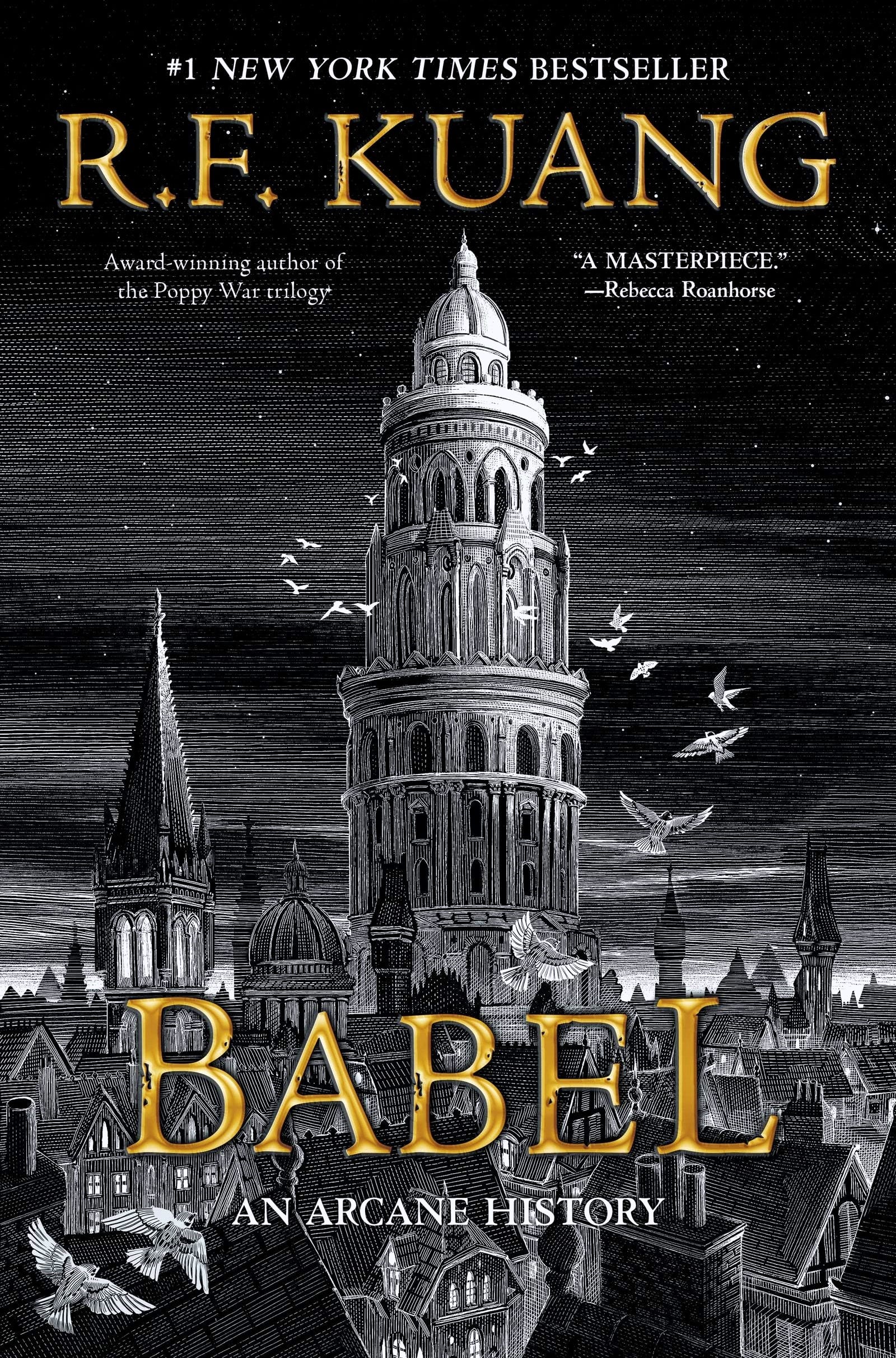
Okay, Fantasy Fam, gather ‘round! Have you ever read a book that just lives in your head for weeks after you finish it? One that makes you rethink language, power, history, and basically everything? Well, buckle up, because R.F. Kuang’s BABEL, or The Necessity of Violence: An Arcane History of the Oxford Translators’ Revolution did exactly that to me, and I am SO hyped to unpack this absolute masterpiece with you all.
Forget your standard Chosen One narratives for a second. Babel is something else entirely. It’s historical fantasy, it’s dark academia, it’s a scathing critique of colonialism, and it’s a deeply personal story about finding your place – or realizing you might not have one. Set in an alternate 1830s Britain where magic powered by translation fuels the Empire, this book is dense, challenging, and utterly brilliant. Let’s dive in!
Plot Synopsis ( MASSIVE SPOILER WARNING! Seriously, ALL the spoilers ahead!)
Alright, let’s get into the nitty-gritty. The story kicks off in 1828 Canton, China. We meet our protagonist, a young boy dying of cholera alongside his family. Just as he’s about to succumb, the enigmatic Professor Richard Lovell appears. Lovell is cold, calculating, and British, and he saves the boy using a silver bar engraved with words in different languages – our first glimpse of the magic system. This silver-working, fueled by the meaning lost in translation between related words (Match-Pairs), is the engine of the British Empire’s global dominance.
Lovell takes the boy from the disease-ridden hovel, leaving his dead mother behind (ouch!), gives him the English name Robin Swift, and spirits him away to Hampstead, London. Why? Because Robin is fluent in Cantonese and Mandarin, and has a knack for languages – exactly what Babel, the Royal Institute of Translation at Oxford, needs. Lovell puts Robin through an intense, isolated decade of rigorous tutoring in Latin, Ancient Greek, and English, preparing him for entry into Babel. His only companions are books and eventually, his tutors. Miss Betty (Elizabeth Slate), his English governess in Canton, is revealed to have been paid by Lovell all along, laying the groundwork for Robin’s linguistic abilities.
Fast forward to the 1830s, Robin arrives at Oxford and enters the hallowed (and slightly terrifying) Babel tower. This place is the heart of Britain’s magical power, a majestic building where silver bars are engraved to perform wonders – strengthening infrastructure, healing, powering industry, and crucially, fueling the military might of the Empire. Robin isn’t alone; Babel specifically recruits students fluent in languages the Empire seeks to exploit, bringing them to Oxford from colonized lands. He quickly forms a tight-knit cohort with three other first-years:
- Ramiz “Ramy” Rafi Mirza: A sharp-witted, anti-colonial student from Calcutta, fluent in Hindi, Urdu, and Persian.
- Letitia “Letty” Price: A practical, initially naive English girl whose estranged father is an admiral, fluent in French and initially resistant to questioning the system.
- Victoire Desgraves: A sharp, observant Haitian girl raised in France, fluent in French and Haitian Creole, carrying hidden burdens and a deep distrust of the Empire.
Together, they navigate the demanding academic life of Babel, studying linguistics, etymology, translation theory, and eventually, the art of silver-working itself. They learn that silver bars work by capturing the “meaning lost in translation” between a word in one language and a related word (often an etymological ancestor or cognate) in another. The greater the slippage in meaning, the more powerful the effect when the silver is activated by a fluent speaker.
However, Robin (and Ramy and Victoire, to varying degrees) becomes increasingly aware of the dark truth: Babel is inextricably linked to British imperialism. The magic they create is used to subjugate nations, including their own homelands. The wealth and power Babel generates directly benefit the Crown and fuel colonial expansion. This creates a powerful internal conflict for Robin: loyalty to his friends and the academic haven Babel offers versus his growing horror at its role in oppressing China and other nations.
This unease is amplified by the presence of the Hermes Society , a shadowy organization of former Babel students working to sabotage the Institute and undermine the Empire’s silver supply. Robin encounters Griffin Lovell , Professor Lovell’s estranged elder son (and Robin’s half-brother, though Robin doesn’t know this for a while), who is a key figure in Hermes. Griffin tries to recruit Robin, revealing the extent of Babel’s complicity and urging him to act as a double agent.
The central plot escalates as Britain prepares for war with China – the First Opium War. The conflict is driven by Britain’s desire to force China to accept opium imports (grown in British India) to balance the trade deficit caused by Britain’s insatiable demand for Chinese tea, silk, and porcelain, which they pay for primarily with silver, draining Britain’s reserves. Babel is crucial to the war effort, needed to create silver bars that enhance British naval power and weaponry.
Robin is caught in the middle. He undertakes missions for Hermes, stealing silver and information, while trying to maintain his position within Babel. His friendships are tested: Ramy is fiercely anti-colonial and supportive of Hermes; Victoire is cautious but sympathetic to the cause due to her own history; Letty remains loyal to Britain and Babel, creating significant friction within the group. Professor Lovell becomes increasingly suspicious and manipulative, representing the cold, utilitarian logic of the Empire.
Several key events push Robin towards radicalization:
- Betrayal in Canton: During a university-sanctioned trip back to Canton (ostensibly for research but really to aid British merchants and diplomats), Robin witnesses firsthand the devastating effects of opium and the arrogance of the British. He’s forced to make choices that compromise his morals and further alienate him from Babel’s mission.
- Letty’s Betrayal: Letty, horrified by the group’s increasingly radical actions and unwavering in her loyalty to England, eventually betrays them to the Babel authorities, though the immediate consequences are initially unclear.
- Ramy’s Death: This is the point of no return. During a confrontation stemming from Letty’s actions (or perhaps unrelated Hermes activity, the trigger is slightly complex and involves escalating tensions), Ramy is tragically killed. His death shatters the remaining innocence of the group and solidifies Robin’s resolve against Babel.
Driven by grief and a burning sense of injustice, Robin realizes that simply leaking information or minor sabotage isn’t enough. He understands that Babel itself is the engine of oppression and must be stopped permanently. He decides that the only way to truly cripple the British Empire is to destroy Babel and its unique ability to harness translation magic on an industrial scale.
The Climax & Ending:
The finale is explosive, both literally and figuratively. Robin, now fully committed to revolution, along with Victoire (Letty having fully sided against them and fled), leads a desperate plan. They know Babel is too well-defended for a conventional attack by Hermes. Instead, Robin uses his deep understanding of silver-working, learned within Babel itself, for a catastrophic purpose.
He discovers (or intuits based on hints from Professor Playfair and linguistic theory) that the concept of “translation” itself is fundamentally paradoxical when engraved on silver. Attempting to manifest the perfect, yet impossible, act of translation via silver creates an unstable, destructive force.
Knowing they are likely sacrificing themselves, Robin and Victoire orchestrate a final stand. They manage to take control of the Babel tower, briefly holding the academics hostage and initiating a “strike” – cutting off the supply of silver-working to the Empire. This causes chaos across Britain as silver-powered technologies begin to fail.
The authorities inevitably respond with force. As soldiers storm the tower, Robin enacts his final plan. He engraves multiple silver bars with the forbidden Match-Pair: Translate/Tradurre (and variations). He strategically places these bars at key structural points within the tower. As the soldiers close in, he activates them.
The effect is devastating. The paradoxical magic rips through the tower, causing it to literally tear itself apart from the inside out. The very magic Babel used to build its power becomes the instrument of its destruction.
In the chaos, Robin confronts Professor Lovell one last time. It’s a gut-wrenching encounter where years of resentment, manipulation, and the complex father-son dynamic explode. Robin ultimately kills Lovell using a silver bar (Bao - explode/burst) given to him by Griffin – a bar Evie Brooke had been murdered with.
The tower collapses. Robin is severely injured. Victoire manages to get them both out just before the final destruction, escaping into the chaos of Oxford. The ending is bittersweet and ambiguous. Babel is destroyed, striking a massive blow against the British Empire’s magical infrastructure. However, the cost has been immense – Ramy, Anthony (a Hermes agent who helped them), Griffin, and countless others are dead. Robin and Victoire are fugitives, their futures uncertain, but they are free from Babel and have irrevocably changed the world. The final lines suggest their fight is far from over, implying they will continue working against the Empire from the shadows.
Character Analysis
Okay, let’s talk about the people who make this story tick! Kuang gives us such a complex, memorable cast.
- Robin Swift: Our boy! Robin’s journey is the heart of the novel. Plucked from poverty and potential death, he’s desperate for belonging and the intellectual sanctuary Babel offers. His core conflict is devastating: embracing the privilege and knowledge Babel provides means betraying his homeland and enabling its oppression. He’s intelligent, linguistically gifted, but also deeply scarred, initially passive, and terrified of losing his place. His arc is one of gradual, painful radicalization, fueled by disillusionment, betrayal, and grief. Key Moment: His decision to finally destroy Babel, embracing the violence he previously abhorred.
- Ramy Mirza: My man! Ramy is the firecracker of the group. Coming from Calcutta, he’s keenly aware of the Empire’s hypocrisy from the start. He’s charming, fiercely intelligent, loyal, and passionately anti-colonial. He often challenges Robin and pushes the group towards action. His friendship with Robin is central, providing both support and ideological friction. His death is the catalyst for the novel’s final act.
- Victoire Desgraves: The quiet storm. Victoire is incredibly observant and carries the weight of her hidden Haitian heritage and traumatic past in France. She’s initially cautious, perhaps the most pragmatic of the group, but her experiences make her deeply empathetic to the anti-colonial cause. Her bond with Robin is subtle but strong, built on shared outsider status. Her resilience and eventual full commitment to the revolution are crucial.
- Letty Price: Oh, Letty. Letty represents the “comfortable” English perspective. She initially enjoys Babel and sees its work as beneficial. She struggles to comprehend the systemic injustice her friends experience and prioritizes her own comfort and national loyalty. While not malicious, her privilege makes her blind, leading to her ultimate betrayal of her friends. She serves as a powerful foil, highlighting the chasm between the colonizer and the colonized.
- Professor Lovell: The manipulative father figure. Cold, calculating, and utterly dedicated to the Empire. He rescues Robin but sees him purely as a tool, a linguistic resource to be exploited. His relationship with Robin is fraught with unspoken tension, control, and a disturbing lack of affection. He embodies the dehumanizing logic of imperialism.
- Griffin Lovell: The radical brother. Professor Lovell’s disowned son and Robin’s half-brother. He’s the face of the Hermes Society for Robin – angry, cynical, and committed to destroying Babel through any means necessary. He pushes Robin towards action but is also damaged and perhaps reckless. His existence complicates Robin’s identity and loyalties.
Thematic Resonance
This book is THICK with themes, guys. Kuang doesn’t pull any punches.
- Language is Power: This is the big one. The magic system literally weaponizes language and translation. Control over translation means control over reality, technology, and empire. Kuang explores how translation isn’t neutral, it’s an act of interpretation, appropriation, and often, violence.
- Colonialism and Imperialism: Babel is a searing indictment of the British Empire. It lays bare the exploitation, racism, and violence inherent in the colonial project, showing how academic institutions like Babel were essential tools for imperial expansion and control.
- Identity, Belonging, and Otherness: Robin and his cohort constantly grapple with their identities as outsiders within the heart of the Empire. They are valued for their linguistic skills but simultaneously ‘othered’ and distrusted. The novel explores the pain of assimilation, the yearning for home, and the impossibility of truly belonging in a system designed to exclude you.
- The Necessity (or not?) of Violence: The subtitle says it all. The book constantly questions whether violence is a justifiable, or even necessary, tool against systemic oppression. It doesn’t offer easy answers, showing the horrific costs and moral compromises involved.
- Betrayal: From Lovell’s manipulation of Robin to Letty’s betrayal of her friends, and Robin’s own complex betrayals (of Hermes, of Babel, arguably of his friends’ trust at times), the theme runs deep on personal and systemic levels.
- Dark Academia: The novel critiques the romanticized image of academia, exposing the elitism, complicity in power structures, and potential for knowledge to be used for nefarious ends.
World-Building Deep Dive
Kuang’s world-building is meticulous and grounded, making the fantasy elements feel chillingly real.
-
Setting: An alternate 1830s Oxford/London/Britain. Kuang masterfully blends real historical details (the architecture, social norms, political tensions like the Opium Wars, early industrial revolution anxieties) with her magical conceit. As her Author’s Note confirms, she took specific, calculated liberties with dates and locations to serve the story, making the setting feel both familiar and unsettlingly different. Oxford, particularly Babel, feels like a character in itself.
-
Magic System - Silver-Working: This is the core innovation.
- Mechanism: Based on engraving Match-Pairs (related words from different languages, often with etymological links) onto silver bars.
- Power Source: The “meaning lost in translation” – the conceptual gap or nuance difference between the words in the pair. The bigger the gap, the stronger the effect.
- Activation: Requires a native or highly fluent speaker of both languages involved to activate the bar by speaking the words.
- Effects: Wide-ranging, from healing (Lovell saving Robin) and enhancing materials (stronger ships, faster carriages) to infrastructural improvements (cleaner water, stable buildings) and potentially destructive forces (Griffin’s hints, Robin’s final act).
- Limitations: Requires silver, specific linguistic knowledge, fluency, and the bars degrade over time or with heavy use. The impossibility of perfect translation also creates paradoxes (like the Translate/Tradurre bar).
-
Babel - The Institution: The Royal Institute of Translation. Housed in a magnificent, magically-enhanced tower in Oxford. It’s the center of silver-working research and production, the engine driving British global power. It’s hierarchical, elitist, and deeply intertwined with government and colonial ventures. Recruits internationally but primarily serves British interests.
-
The Hermes Society: The underground resistance. Composed mainly of former Babel students disillusioned with the Empire. They use stolen silver and knowledge to sabotage Babel and support anti-colonial movements. Their methods are covert and sometimes violent. Their existence highlights the moral conflict at Babel’s core.
Genre Context & Comparisons
Babel sits beautifully at the intersection of several subgenres:
- Historical Fantasy: Like Susanna Clarke’s Jonathan Strange & Mr Norrell, it masterfully integrates magic into a specific, well-researched historical period, using the magic to explore and critique the era’s power dynamics.
- Dark Academia: Think Donna Tartt’s The Secret History but with higher, geopolitical stakes. It captures the intense, often toxic atmosphere of elite academic institutions, the allure of knowledge, and the moral compromises made in its pursuit.
- Linguistic Fantasy: While others use language in magic, Babel’s magic is language. It delves into translation theory, etymology, and the Sapir-Whorf hypothesis (the idea that language shapes thought) in a way few fantasy novels do.
- Kuang’s Own Work: It shares themes of colonialism, war, trauma, and the cost of power with The Poppy War trilogy, but shifts the focus from military fantasy to an academic/linguistic setting, offering a different but equally potent critique.
Compared to much mainstream fantasy, Babel is slower-paced (initially), denser, and more overtly political. Its magic system is intricate and conceptual rather than flashy. It’s less about adventure and more about ideology, history, and the weight of choices.
Influences & Inspirations
You can really see the layers here:
- History: The Opium Wars, 19th-century British imperialism, the history of Oxford University, early industrial revolution anxieties, the history of translation and linguistics are all foundational. Kuang’s Author’s Note explicitly details her historical research.
- Linguistics: The magic system itself is a fascinating exploration of translation theory, etymology, and the power dynamics inherent in language contact. Ideas reminiscent of translation theorists like Schleiermacher (mentioned by Playfair) and the concept of untranslatability are central.
- Literature: The dark academia genre, critiques of colonialism found in post-colonial literature (though presented within a fantasy framework). The specific authors Kuang mentions using for research (Moore, Bede, Thackeray etc.) clearly shaped the historical feel.
- Personal: Kuang’s own background as a translator and her academic studies in Chinese history undoubtedly inform the novel’s depth and perspective.
Key Takeaways
If you take anything away from Babel , let it be these points:
- Language isn’t just communication; it’s a tool of power, capable of shaping reality and empires.
- Translation is never neutral; it’s an act loaded with cultural assumptions, potential appropriation, and violence.
- Academic institutions, however prestigious, can be deeply complicit in systems of oppression and exploitation.
- Colonialism extracts resources, including linguistic and cultural knowledge, often causing irreparable harm to the colonized.
- Resistance against overwhelming power is complex, costly, and raises profound questions about the necessity and morality of violence.
- Finding belonging as an outsider in a hostile system is a fraught, painful process, often demanding impossible choices.
- History is not a fixed narrative but a contested space, shaped by those who hold the power to translate and interpret it.
Wrapping It Up
Wow. Okay. Babel is an absolute triumph. It’s intellectually stimulating, emotionally devastating, and politically charged. Kuang weaves history, magic, and linguistics into a narrative that is both epic in scope and deeply personal. The characters are flawed, compelling, and will break your heart. The world-building is intricate and believable, the magic system is one of the most original I’ve encountered in years, and the critique of empire is razor-sharp.
It’s not always an easy read – it’s dense, demands attention, and tackles heavy themes without flinching. But the payoff is immense. It’s a book that makes you think and feel deeply. If you’re looking for a fantasy novel that goes beyond escapism, that challenges you and stays with you long after the final page, you need to read Babel. It’s easily one of the best books I’ve read, period. Highly, highly recommended! Go get it!