Blood over Bright Haven
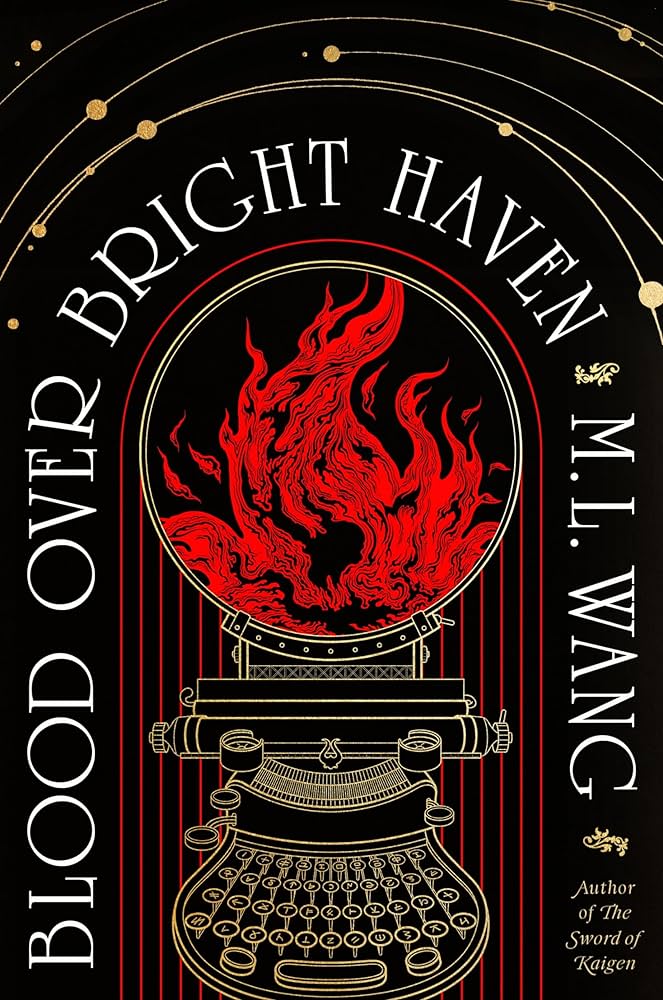
Hey there, fellow fantasy fanatics! 👋 Have you ever picked up a book that just grabs you by the throat, stares you dead in the eye, and demands your full attention? Well, let me tell you, M. L. Wang’s Blood Over Bright Haven did precisely that to me. I went in expecting a cool magic system and maybe some political intrigue, but what I got was a gut-punch of a story that’s as brilliant as it is brutal. This isn’t just another fantasy novel, folks; it’s a deep dive into the ugly truths hidden beneath shining facades, and it’s absolutely unforgettable. Let’s break it down!
Plot Synopsis: The City of Lights, The Price of Darkness 🤯
Blood Over Bright Haven kicks off in the brutal, snow-swept Kwen, a land outside the supposedly blessed city of Tiran. We meet Thomil Siernes-Caldonn, one of the last survivors of his tribe, the Caldonnae. His people have been decimated by a mysterious plague called Blight, which literally unravels living beings into ribbons of light, flesh, and bone. Thomil and the dwindling remnants of his clan, including his older sister Maeva and her husband Arras (and their young daughter, Carra), are making a desperate run across the frozen Lake Tiran towards the glittering, magically shielded city. This journey, known as “the crossing,” is their last hope.
As they attempt the crossing, the Blight strikes repeatedly, taking down Thomil’s friends and family in horrifying fashion – Drevan, Elra, Elra’s mother, Landir, Rhiga, Traehem, Mirach, and eventually, the strong lead hunter, Beyern. The climax of this harrowing opening sees Arras disintegrate into a bloody “flower” on the ice, but not before Maeva heroically snatches Carra from his arms. Maeva then sacrifices herself by falling through the ice to give Thomil a chance to get Carra to safety. Thomil, witnessing unimaginable horror and personal loss, makes it to the city’s barrier with an unconscious Carra, lying to the Tiranish guards that she’s his daughter to prevent her being thrown back into the Blight. He collapses, physically and emotionally shattered, but Carra is alive.
We then shift perspectives to Sciona Freynan, a prodigiously talented but socially awkward and intensely ambitious young woman living in Tiran. She’s about to take the High Magistry exam, a near-impossible feat, especially for a woman – no female has ever passed. Her loving but traditional Aunt Winny and practical cousin Alba support her, though Sciona feels the immense pressure of representing all women who aspire to high-level magic. Sciona’s exam is a tense affair, showing off her unique skills in “sourcing” (pulling energy from the Otherrealm) and “mapping” (visualizing energy sources). She excels, easily outshining privileged but mediocre rivals like Jerrin Mordra. Her crowning moment is defiantly re-attempting a cauldron levitation after accidentally sending it through the ceiling, proving her raw power and defiance. She’s admitted to the High Magistry, a monumental achievement.
Sciona’s new life as a highmage is less glorious than expected. Her male colleagues (Cleon Renthorn, Yurith Tanrel, Farion Halaros) immediately ostracize and belittle her. As a petty insult, Renthorn assigns her Thomil, a quiet Kwen janitor, as her assistant. Sciona, initially annoyed, soon finds Thomil to be an incredibly perceptive and intelligent sounding board for her complex theories. Despite her social awkwardness, she slowly begins to rely on his unique perspective. Their professional relationship deepens, and Sciona’s ambition to create an even clearer mapping spell becomes their shared mission.
During their work, an explosion occurs in Halaros’s lab. Sciona deduces it was caused by a cursed spellograph, planted by Renthorn to clear out rivals and absorb them into his team for the upcoming barrier expansion project. This fuels Sciona’s determination to surpass Renthorn. More importantly, Sciona and Thomil’s conversations delve into the history of magic. Thomil reveals that the powerful runes of Tiranish magic originated with the Kwen, specifically the Endrastae of the Venhold Mountains, whose female practitioners, the “meidrae” or “witches,” wielded immense power. He also hints at the horrifying truth about Blight.
Driven by Thomil’s insights, Sciona researches Archmage Andrethen Stravos, one of Tiran’s founders, who was half-Kwen. She discovers that Stravos’s unique mapping methods, long abandoned by Tiran for being “arcane,” are the key to truly clear visuals of the Otherrealm. She develops two new mapping spells: the improved Stravos-Kaedor method and the revolutionary Freynan Mirror, which promises a perfect, color image of the Otherrealm. Thomil urges caution, hinting at dangerous truths.
The turning point comes when Sciona activates the Freynan Mirror. Instead of an abstract energy field, she sees the Kwen lands in vivid color – a snowy meadow, animals, and then a group of black-haired humans on an ocean shoreline. Her joy turns to absolute horror as she siphons energy from a bush, only to see it disintegrate like a Blighted victim. Then, in an attempt to prove it wasn’t human life being taken, she siphons from the ocean, accidentally striking a young black-haired woman. The woman unravels in front of her eyes, consumed by light and blood, just like Thomil’s family.
Sciona is utterly shattered. Thomil, seeing her horror, throws the spellograph to stop her, confirming his fears: the “Otherrealm” is the Kwen lands and other parts of the mortal world, and Blight is the effect of Tiranish siphoning, taking lives to power their city. Thomil confronts Sciona with the full, devastating truth: Tiran’s prosperity is built on the mass murder of innocent life, justified by religious and racial superiority. He reveals that the Forbidden Coordinates are actually Tiran itself, allowing Sabernyn (the “traitor mage”) to siphon from his rivals’ homes, effectively Blighting them. The very barrier that protects Tiran is a constant act of mass murder, devouring Kwen and wildlife in “Reserve siphoning zones” like the crossing.
Sciona, in a state of utter despair, confides in her mentor, Bringham. He confirms everything, revealing that the entire High Magistry and senior government officials know the truth, and have for generations. Bringham coldly justifies it as a “necessary burden” for Tiran’s progress, dismissing Sciona’s horror as “emotional” and “unwomanly.” He even reveals that his textile factories’ dyes cause sterility in Kwen women, seeing it as a “solution” to overpopulation. Sciona is repulsed, realizing her hero is a monster.
In her breakdown, Sciona is nearly lobotomized by a medical alchemist, Doctor Mellier, who believes her truth-telling is “female hysteria.” Sciona, clinging to her pride and intellectual integrity, frightens him away. She then talks to Ansel, the baker’s son, who confirms his brother, a former barrier guard, committed suicide after witnessing Blight at the border and being forced to participate in sending Kwen back to their deaths. This fuels Sciona’s resolve.
Sciona goes to Thomil’s apartment, confesses the full truth, and apologizes for her previous cruelty. Thomil, now with Carra by his side, initially expresses his deep distrust of Tiran and his anger at Sciona. Carra, a fierce, hardened survivor of the crossing, attempts to stab Sciona, furious that a mage benefited from her family’s deaths. Thomil restrains her, and Sciona, in a desperate gamble, proposes a plan: she will reveal the truth of the Freynan Mirrors to the entire city at the upcoming Council meeting, showing everyone where their magic comes from. Thomil is reluctant, fearing retaliation against Sciona and the Kwen, but eventually agrees to help her.
The climax is set for Feryn’s Feast, the day of Sciona’s presentation and her planned reveal. Sciona works furiously, transforming her “Freynan Mirrors” into a massive, city-wide spellweb that will project the Blight onto every public utility in Tiran. She sends Thomil and Carra to activate the spell from the secret siphoning towers. At the trial, Sciona defiantly unveils her spell, accusing the Council of mass murder and deceit, exposing her father, Perramis, as complicit. The Council orders her arrest.
As Tiran’s clocks strike noon, the barrier expansion spell is activated. The entire city is plunged into chaos as Freynan Mirrors activate on every light, every vehicle, every magically powered appliance. Citizens witness in horrifying color the constant siphoning of animals and humans from the Kwen. Riots erupt as Kwen and Tiranish clash in the streets. Sciona is arrested by guards, but Bringham pulls strings to take custody of her, transporting her through the burning, rioting city in Duris’s armored car. At Bringham’s mansion, Sciona realizes his final act of “protection” is just another way for him to feel good about himself. She violently confronts him, seeing his true monstrous nature as he brutally massacres Kwen trying to breach his gates. Sciona is knocked unconscious.
Meanwhile, Thomil and Carra, from their vantage point on a Kwen Quarter rooftop, watch the city burn. Thomil, despite his internal conflict and fear for Sciona, eventually activates the final component of Sciona’s plan: the expansion spell that targets Leon’s Hall. The barrier expands westward, drawing its energy by siphoning everything and everyone inside the Main Magistry Building, consuming the entire High Magistry, the Council, and other government officials in a massive, beautiful, red bloom of Blight.
Thomil and Carra are soon confronted by Renthorn and Jerrin Mordra, who survived by being elsewhere. Renthorn, now ecstatic, declares himself “Archmage Supreme” and demands Sciona’s spellograph to learn how to replicate her magic. Carra, in a brutal, decisive move, launches herself from a water tower, smashing the spellograph through Renthorn’s head, killing him instantly. Thomil, horrified but resolute, spares Jerrin Mordra, hoping that his witnessing the truth and trauma will lead to genuine change in Tiran’s future. Thomil and Carra then join the mass exodus of Kwen, whose rifles and other magical devices have failed due to the siphoning, as they escape the city through the newly expanded, temporary Blight-free barrier, seeking refuge in the Venhold Mountains. Sciona dies, consumed by the Blight she unleashed, her final thoughts a mix of hope for Thomil and Carra, and a deep-seated love rather than vengeance.
Character Analysis: Who’s Who in the Zoo! 🦒
-
Sciona Freynan: Our complicated, brilliant protagonist. Sciona is initially a pure intellectual, driven by an insatiable hunger for knowledge and personal ambition. Her defining trait is her relentless pursuit of truth, often at the expense of social graces or personal comfort. She believes deeply in the inherent goodness of magic and Tiran’s ideals, making her discovery of its true cost utterly devastating. Her arc is a fascinating journey from naïve intellectualism to moral reckoning, culminating in an act of profound self-sacrifice and defiance. She’s not a conventionally “likable” heroine, often selfish and awkward, but her internal struggle and ultimate, horrifying choice make her incredibly compelling and complex. Her relationship with Thomil is pivotal, as he’s the one who forces her to confront truths she’d rather ignore.
-
Thomil Siernes-Caldonn: The stoic, perceptive, and deeply traumatized Kwen survivor. Thomil carries the weight of his lost tribe and the constant indignity of Kwen life in Tiran. He’s a survivor who has learned to “bow and scrape” to the Tiranish, but beneath the surface, he’s a fiercely moral man, guided by Kwen principles of action and consequences over intentions. He initially views Sciona with a healthy cynicism, recognizing the inherent evil of Tiran’s system. Yet, he finds himself drawn to her intellectual curiosity and the unexpected warmth she offers, developing a profound respect and even love for her. His journey is one of rekindled hope and agency, as he moves from passive endurance to active resistance, for Carra, for Sciona, and for his lost people.
-
Carra: Thomil’s niece and a living testament to the Kwen’s suffering and resilience. Scarred both physically and emotionally by Blight and the crossing, Carra embodies the raw, untamed anger of her people. She’s fiercely loyal to Thomil and her Caldonn heritage, rejecting Tiranish civility and demanding direct action. Her bluntness and willingness to embrace violence make her a challenging but vital character, representing the visceral reaction to injustice that contrasts with Sciona’s intellectual journey. She’s a future in the making, shaped by profound loss but still capable of fierce love and defiant hope.
-
Archmage Derrith Bringham: Sciona’s mentor, seemingly the kindest and most benevolent figure in the Magistry. Bringham represents the insidious nature of systemic evil. He genuinely cares for Sciona and believes in her potential, but he is fully aware of Tiran’s dark secrets. His “kindness” is a rationalization, a way for him to feel good about himself while perpetuating immense suffering. He seeks “absolution” through Sciona’s achievements, seeing her as a way to balance his own moral ledger. His transformation from a seemingly good man to a chillingly detached killer, capable of brutalizing Kwen without remorse, is one of the most disturbing aspects of the book.
-
Cleon Renthorn: Sciona’s primary rival and the embodiment of overt, narcissistic evil within the Magistry. He’s ambitious, cruel, and takes perverse pleasure in the exploitation of others, especially the Kwen and women. Unlike Bringham, he doesn’t hide behind a veneer of benevolence; he embraces the “conqueror” mentality of Tiran’s founders. His actions, like planting the cursed spellograph and assaulting Sciona, make him a clear antagonist, but his twisted “honesty” about the nature of power is a chilling reflection of Tiran’s true values.
-
Jerrin Mordra: Another rival, less talented and more privileged. Mordra serves as a foil to Renthorn, initially oblivious to the horrors of Tiran’s magic. His genuine shock and despair upon learning the truth, and his ultimate survival, offer a glimmer of hope that not all Tiranish are irredeemable. His reaction highlights the “normal” Tiranish civilian’s unwitting complicity.
Thematic Resonance: Beyond the Magic! ✨
This book is absolutely brimming with weighty themes, explored with unflinching honesty.
-
Truth vs. Delusion: At its heart, this is a story about confronting uncomfortable truths. Tiran is built on a grand lie about the source of its power, maintained by deliberate delusion and selective blindness. Sciona’s journey is a relentless pursuit of this truth, even when it shatters her world and alienates her from everyone she knows. The book contrasts Sciona’s intellectual honesty with the calculated denial of the Archmages and the comfortable ignorance of the general populace.
-
Power and Corruption: The magic system itself is a metaphor for power. It’s not inherently evil, but its application by the Tiranish leadership reveals its corrupting influence. The leaders rationalize mass murder for their city’s prosperity, illustrating how power can warp morality and justify atrocities under the guise of “progress” or “divine will.”
-
Colonialism and Oppression: This is a thinly veiled allegory for historical colonialism and indigenous oppression. The Tiranish exploit the Kwen’s land and lives, justifying it through fabricated religious doctrine (the Kwen as “heathens,” Blight as “punishment”) and racial superiority. The Kwen are dehumanized, forced into labor, and their deaths are dismissed as inconsequential. The very foundation of Tiran, built on stolen magic and blighted lands, mirrors the real-world consequences of colonial expansion.
-
Identity and Belonging: Sciona grapples with her identity as a woman in a patriarchal system, a “bastard” trying to earn her place, and eventually, a truth-teller shunned by her own people. Thomil and Carra navigate their Kwen identity in a city that demands assimilation or invisibility. Their fierce pride in their heritage contrasts with Tiran’s demands.
-
Morality and Ethics: The book presents a stark ethical dilemma: Is intent or outcome more important? Tiranish morality values good intentions (even if they lead to harm), while Kwen morality judges by actions and their tangible effects on the world. This clash is central to Sciona’s internal conflict and her arguments with Bringham and Thomil. It forces the reader to question their own moral compass.
-
Sacrifice and Legacy: Characters are constantly making sacrifices. Thomil and Maeva sacrifice everything for Carra’s survival. Sciona sacrifices her career, her relationships, and ultimately her life for the truth. The question of what kind of legacy one leaves – a hidden, bloody one or a defiant, destructive one – is powerfully explored.
World-Building Deep Dive: A World Built on Blood! 🩸
Wang has crafted a truly unique and disturbing world that feels both fantastical and eerily familiar.
- Tiran: The Bright Haven: This is the jewel of civilization, a technologically advanced city powered by magic. It’s presented as a beacon of light, safety, and progress in a “blighted” world. Its architecture is grand, its systems (trains, electricity, climate control) are marvels. But the stark contrast between its shining facade and its dark, hidden foundation is the central irony.
- The Barrier: A literal magical shield that protects Tiran from the outside world, creating an eternal spring within. It’s a miracle of engineering, but it’s also a constant, living act of siphoning, drawing life energy from the outside. Its expansion is the plot’s central goal, unaware to the people that it’s just expanding the death zone.
- The Magic System:
- Sourcing and Mapping: This is the core of Tiran’s magic. Mages “map” (visualize) the “Otherrealm” and “source” (pull) energy from it. Different mapping methods (Leon, Kaedor, Erafin) offer varying clarity.
- Conduits: Magical objects (staffs, wands, rings, even customized voice-activated cylinders) that anchor and direct spells. Archmage staffs are particularly powerful.
- The Reserve: A centralized energy pool that powers Tiran’s public utilities, constantly refilled by continuous siphoning from designated “Reserve siphoning zones.”
- The “Otherrealm”: This is the biggest reveal. It’s not another dimension. It’s simply the Kwen lands and other parts of the mortal world beyond Tiran’s barrier.
- Blight: The visible, horrifying manifestation of Tiranish siphoning. When energy is pulled from a living creature, the creature unravels in light and blood, just like Thomil’s family. It’s not a natural disease but a man-made consequence of magic.
- Forbidden Coordinates: These are coordinates within the mapping system that cause particularly gruesome and localized siphoning. They are revealed to correspond to locations within Tiran itself, making it possible for mages like Sabernyn to “Blight” their rivals’ homes.
- The Kwen: The indigenous people who live beyond the barrier. They are diverse (Caldonnae, Endrastae, Mersyn) with rich oral traditions, unique spiritual beliefs (polytheistic, valuing action/outcome over intent), and a deep connection to their land. They are physically characterized by copper hair and gray eyes. Tiran views them as “heathens,” “savages,” and “unworthy,” exploiting them for labor and resources.
- Meidrae: The female magic practitioners of the Pre-Tiran Kwen, who possessed advanced “witch mirrors” (the inspiration for Sciona’s Freynan Mirror) that offered clear visions of the world, including the “Otherrealm.” Their magic was traditionally protective and tied to community.
- Tiran’s Religion (Feryn): A monotheistic religion that claims God gifted magic to Leon and his followers to build Tiran. This religion is used to justify the exploitation of the Kwen and the maintenance of the city’s power structure. The various religious texts (The Leonid, The Tirasid) are foundational but also tools of manipulation and historical revision.
- Social Structure: A rigid hierarchy exists: Archmages (the elite ruling council), Highmages (top-tier practitioners), junior researchers, and then the general Tiranish populace. Kwen are at the very bottom, effectively an exploited underclass. The patriarchy is deeply entrenched, limiting women’s roles even within the powerful Magistry.
Genre Context & Comparisons: Where Does it Fit? 🗺️
Blood Over Bright Haven confidently strides into the grimdark fantasy subgenre, not shying away from uncomfortable moral ambiguities and visceral violence. It definitely delivers on the “dark” part, with themes of systemic oppression, genocide, and casual cruelty.
- Steampunk/Gaslamp Fantasy: The blend of magical technology with an industrial-era setting (trains, factories, cobbled streets) gives it a strong gaslamp aesthetic, similar to a darker Foundryside by Robert Jackson Bennett, where the magic system directly manipulates reality and has far-reaching consequences.
- Colonialism Allegory: It stands alongside contemporary fantasy novels like R.F. Kuang’s The Poppy War or Tamsyn Muir’s Gideon the Ninth (for its deep historical secrets and complicated, often queer, protagonists), but with a much more direct and central focus on the horrific costs of “civilization” built on the backs of an exploited indigenous population. It reminded me of The City We Became by N.K. Jemisin in how it explores the living, breathing nature of a city and its hidden, monstrous aspects.
- Deconstruction of Chosen One/Civilization Tropes: The book flips the script on classic fantasy tropes where a shining city saves humanity from darkness. Instead, Tiran is the darkness, the “Blight” is its weapon, and its “chosen” status is a self-serving lie. This deconstruction makes it a fascinating read for those tired of conventional heroic narratives.
- Character-Driven Complexity: While the world-building is intricate, the story is deeply character-driven, exploring the psychological toll of truth and the capacity for both good and evil within individuals. Sciona’s journey is a powerful exploration of a flawed protagonist’s moral awakening.
Influences & Inspirations: Behind the Pages! ✍️
It’s clear that M.L. Wang is drawing from a rich tapestry of influences to weave this narrative.
- Historical Colonialism: The parallels to historical colonialism are undeniable. The “discovery” and appropriation of indigenous knowledge, the forced conversion, the justification of violence through religious or racial superiority, the exploitation of resources (land, people) – it all screams historical echoes. The Kwen’s experience reflects the devastating impact of European expansion on indigenous populations.
- Industrial Revolution and its Costs: The book touches on the harsh realities of the Industrial Revolution, where technological advancement often came at the cost of worker safety and environmental degradation. Bringham’s factories, the dangerous dyes, and the casual disregard for Kwen workers’ lives directly reflect this era.
- Feminist Themes: The patriarchal society of Tiran and the systemic barriers faced by women are a clear influence. Sciona’s struggle to be recognized for her intellect in a male-dominated field, the casual misogyny she faces, and the tragic fates of women like Irma Mordra (driven mad, institutionalized) or Kaedelli (sterilized by factory work) highlight the author’s exploration of feminist issues within the fantasy framework. The concept of the “meidrae” as powerful female magic users before Tiran offers a powerful counter-narrative.
- Religious Critique: The critical examination of how religion can be warped to justify atrocities is a significant influence. Feryn, Tiran’s God, is used to rationalize mass murder and oppression, turning divine will into a tool for conquest and control. This invites readers to question the narratives they accept without scrutiny.
- Psychological Depth: The book delves into the psychological impact of trauma and moral compromise. Thomil’s numbness and Carra’s rage are direct consequences of their past. Bringham’s calm detachment in the face of horrific actions speaks to a deep psychological cost. Sciona’s breakdown and her struggle to integrate devastating truth reflect a keen understanding of human coping mechanisms.
Key Takeaways: The TL;DR for Your Brain! 🧠
- Magic, power, and progress often have a hidden, horrifying human cost.
- Truth is rarely comforting and can dismantle entire worldviews.
- Systemic oppression is built on layers of comfortable lies and dehumanization.
- Heroism can emerge from deeply flawed individuals and unexpected places.
- The bonds of family and community offer resilience against overwhelming evil.
- The narrative challenges readers to question authority, received history, and their own complicity.
- Justice isn’t always neat, and sometimes, the only way forward is through immense destruction.
Wrapping It Up: Final Thoughts! 💖
Holy smokes, Blood Over Bright Haven is a masterpiece of dark fantasy! M. L. Wang has crafted a story that is intellectually stimulating, emotionally devastating, and utterly compelling. It’s a challenging read, for sure – it doesn’t pull its punches when it comes to the horrors of oppression and the psychological toll of complicity. But that’s precisely why it’s so vital. This book will make you think, make you feel, and stay with you long after you’ve turned the final page.