Grave Empire
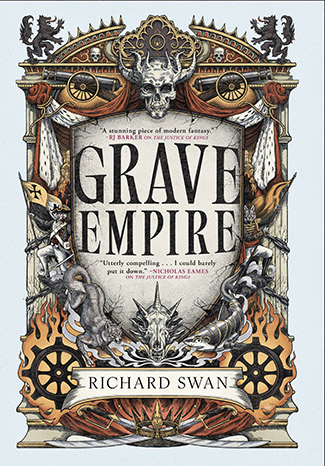
Alright folks, settle in, grab your preferred brew (mine’s a strong black coffee this morning), because we are diving DEEP into Richard Swan’s latest behemoth, Grave Empire. And let me tell you, this isn’t just a book; it’s an experience. Swan is crafting something truly special with this “Great Silence” series, and if this first entry is anything to go by, we’re in for one heck of a ride. Strap yourselves in, because there are full spoilers ahead – you’ve been warned! 🚀
Plot Synopsis: A World on the Brink
Okay, so “Grave Empire” throws us headfirst into a sprawling, gunpowder-and-sorcery-soaked world teetering on multiple precipices. Swan masterfully juggles two primary narrative threads that eventually, and quite spectacularly, begin to converge.
Peter Kleist’s Ordeal in the New East: We start with young Lieutenant Peter Kleist, a somewhat reluctant officer of the Sovan Army. He’s journeying from the heart of the Sovan Empire to the volatile New East, specifically the Alda River Valley. This isn’t your grand, civilized warfare; the New East is a gloomy, mist-shrouded frontier, rife with pagan tribes, Casimiran and Sanque enemies, and something… else.
- Peter’s initial letters home perfectly capture his mounting dread and homesickness. He witnesses the brutal aftermath of an attack on Sovan soldiers – bodies rent and mauled, a head impaled – a grim welcome to his new posting at Fort Ingomar, the “fort at the end of the world.”
- Fort Ingomar is a miserable place. The soldiers are surly, the commanding officer Major Haak is cryptic, and the nights are plagued by inexplicable screaming and weeping sounds that seem to emanate from the very fabric of the aether. Peter experiences a terrifying hallucination of a mutilated soldier warning him of impending doom.
- Haak, convinced there’s more to these occurrences than simple enemy tactics or madness, tasks Peter (now brevet Captain) with leading an expedition north. Their mission: investigate a new Casimiran/Sanque fortification at the Ena Split and, more importantly, uncover the source of the supernatural phenomena plaguing the valley.
- The journey is arduous. Peter struggles with leadership, the men are on edge, and the eerie occurrences intensify. They find strange fetishes, hear whispers on the wind (like “Pistu,” meaning “crush,” moments before a cannon accident), and Peter sees a gruesome, ritualistic arrangement of a soldier’s viscera, along with disembodied eyes watching from the forest.
- They reach the Ena Split and, after a brutal flintlock battle, manage to capture the fort. A Sanque prisoner raves about “monsters” from the north-east attacking during a “blood moon.” This aligns with Haak’s secondary objective for Peter: to investigate these “monsters.”
- Against his better judgment, but driven by orders and a desperate need to prove himself, Peter leads a smaller detachment of thirty men, including the pagan scout Olwin and Captain Furlan (the artillery officer who became a reluctant mentor), into the uncharted foothills of the Great Northern Barrier Range – “monster country.”
- They discover an ancient, abandoned pagan hall. That night, they are attacked by terrifying “Kato” – seven-foot-tall, black-furred, jaguar-like humanoids. The battle is a massacre. Most of Peter’s men are slaughtered.
- Peter, Furlan, Olwin, and a few other survivors are captured. They witness a horrific ritual where Furlan is vivisected, his organs replaced, and somehow kept alive, transforming before their eyes. The Kato shaman uses a golden spearhead in this ritual. Peter realizes this is the fate awaiting them all.
- During a desperate escape attempt, Peter is recaptured after a strange, hallucinatory encounter with a “tree-man” (a Neman missionary seemingly fused with a tree, impaled by the same golden spearhead) who imparts cryptic visions and a splinter into Peter’s hand. The tree-man seems to have some control over the Kato.
- Furlan, now transformed into a Kato but retaining some human consciousness, helps Peter escape again, revealing that the Kato are psychically “inert” to the aethereal screaming that plagues others. He tells Peter the golden spear is an “old relic” that “turns” people into Kato.
- The ritual vivisection begins on Peter. However, it’s interrupted – possibly by the tree-man’s influence or the splinter. He’s rescued/spirited away, changed but not fully transformed into a Kato. His abdomen is stitched up, but he’s missing organs.
- Peter, guided by visions of Olwin (who seems to have truly escaped), makes a harrowing journey south, his body rejecting food and water, his hand with the splinter beginning to ossify. He reaches the Ena Split, now a fortified Sovan position under Major Hanna (Haak having committed suicide), and collapses.
- His tales of catmen are dismissed as madness. He’s eventually shipped back to Sova via Port Gero, catatonic for much of the journey, plagued by visions and the unshakeable feeling that the New East has fundamentally changed him. He is taken to the Royal Naval Hospital in Sova.
Renata Rainer’s Diplomatic Nightmare: Parallel to Peter’s ordeal, we follow Renata Rainer, a junior secretary in the Stygion Mer-men Office in Sova. She’s intelligent and dedicated but works in a largely ignored and mocked department.
- After a humiliating prank by colleagues, a genuine summons arrives. She and her superior, Ambassador Didacus Maruska, are tasked by Colonel Glaser of the Imperial Life Guards to accompany two Bruta Sarkan monks, Brother Herschel and Brother Guillot, on a diplomatic mission.
- The monks, practitioners of illegal death magicks (séances), reveal a prophecy of the “Great Silence” – the afterlife has fallen silent, portending a cosmic doom. They need to consult with other magickal practitioners: the Kasar (wolfmen) in the Kyarai and the Stygion (mer-men) in the Jade Sea.
- As they prepare to leave Sova, Renata’s coach is bombed. Her half-sister Amara is grievously wounded by a pistol shot from an assassin. Renata gives chase into the Dynast’s Palace, where she is nearly killed but unknowingly saved by Count Lamprecht von Oldenburg. Amara’s wound becomes badly infected.
- The diplomatic mission, now including Colonel Glaser himself and a gruff engineer named Azura Ozolinsh, sets off south. The journey is long, and tensions rise. Renata is plagued by nightmares of a vast wall and her sister in peril. Ozolinsh and Herschel also experience a growing unease, a sense of wrongness in the aether.
- They discover the Bruta Sarkan fortress at Zetland abandoned, a message “ALL DEAD INSIDE” daubed on the gates. Herschel confesses the order had planned a dangerous summoning ritual after they lost contact with the afterlife, which likely went catastrophically wrong.
- They reach Kalegosfort in the northern Kyarai, a city on the brink as the Sovan war effort against the Sudreik Kasar (allied with Casimir) collapses. Here, Renata meets the cynical but capable Captain Joseph Lyzander, who is to guide them into the besieged Kasari capital, Port Talaka. Renata also receives a mysterious, perfumed letter from the Empress Zelenka Haugenate for Lyzander.
- The journey to Port Talaka is a desperate rush through refugee-choked roads and active warzones. At one point, Colonel Glaser orders Sovan soldiers to fire on refugees blocking a bridge to clear the way, a brutal act that horrifies Renata.
- In a secluded alley in Port Talaka, Brother Guillot suddenly murders Ambassador Maruska. He reveals himself to Renata as “the Knackerman,” an agent of some dark power, his human face sloughing away to reveal a golden plate inscribed with runes. He claims their mission to stop the Great Silence is futile. Renata is saved by a mysterious stranger (Broz, von Oldenburg’s agent, though she doesn’t know it).
- Renata and Lyzander, guided by a Hyernakryger (Kasari temple guard) named Ran-Juma, navigate the besieged Spiritsraad (the Kasari spiritual center). They meet the Dwelkspreker, the Kasari high shaman. She confirms the Great Silence and speaks of a consuming entity. She gives them the “Blood Stone,” a powerful magickal amplifier, and cryptically says, “Rot your soul.” They also see a quarantined Kasari shaman driven mad by whatever is in the afterlife.
- They escape Port Talaka as it falls and head for Port Gero to reach the Stygion. The journey is tense. Renata learns Lyzander was a former lover of Empress Zelenka.
- At the Door to the Sea (the Stygion entry point near Port Gero), Renata and Lyzander make contact. After a tense encounter with Stygion guards and their Spear-mounts (white sharks), they are taken by the Stygion ambassador Sina to the tether-city of Ozeanland. Renata learns from the Stygion channeller Muirgen that the Great Silence is caused by the “Vorr,” interdimensional devourers of souls, released from a prison dimension, and that the Eye of the Sea is a potential entry point for them into the mortal plane, an entry that the Blood Stone could facilitate.
- A Casimiran naval force, fresh from victory at Port Talaka, suddenly attacks Port Gero. The Thrice Queen of the Stygion arrives. Renata and Lyzander are tasked with retrieving the Blood Stone from the Sovan fort at Port Gero amidst the battle.
- They infiltrate the fort during the chaotic assault. The Knackerman (now possessing Herschel’s corpse after Glaser accidentally killed him) confronts them, intending to take the Blood Stone. Herschel/Knackerman is obliterated by a cannonball. In the aftermath, the Blood Stone is missing, stolen by Broz during the chaos (though they don’t know by whom). Colonel Glaser is blinded by the Knackerman before its demise.
- Renata, now de facto ambassador, negotiates a tentative peace with the Thrice Queen, promising to seek an end to Sovan aggression in exchange for Stygion help against the Vorr.
Count Lamprecht von Oldenburg’s Machinations: This thread weaves through the others. Von Oldenburg, a powerful Sovan count, is secretly dabbling in forbidden death magicks.
- He “rescues” Renata in Sova, but his true motives are hidden. He’s been bitten by something (implied to be self-inflicted in a ritualistic way) and is healed by his Draedist consort, Yelena Tesařik, at Castle Oldenburg. He is aware of the “plague” (mind rot) in Draedaland and the Selureii death cult’s attempts to suppress news of it. He suspects a connection to the attempt on the Stygion diplomats.
- He leads an expedition into Draedaland with Yelena. They find towns like Toutorix and Elisedd empty, or populated by mindless, zombie-like “vacants.” They witness the mind rot transmitted by touch, accompanied by aethereal screaming. They capture a vacated fusilier.
- Back at Castle Oldenburg, von Oldenburg experiments. He learns to “en-thrall” vacants using a runic ideogram Yelena provides (initially cut, then branded), making them obedient. His first subject, his butler Kyselý, dies from an unrelated injury. He then vacates and en-thralls a scullery maid, Žofia, using a thaumaturgic mechanism he’s developed, powered by Kyselý’s blood, and the brand. He dreams a voice tells him, “THE KEY IS BLOOD.”
- Yelena, horrified by his escalating cruelty and ambition (he plans to create an army of thralls to conquer Casimir and restore a greater Sovan Empire), abandons him, taking his notes and the original blood-filled mechanism.
- Von Oldenburg, enraged but undeterred, still possesses a prototype mechanism and the knowledge of the ideogram. He plans to continue his work. He’s last seen in Verdabaro, Draedaland, having tortured Selureii shamans for information about the mind rot/Vorr. His agent, Broz (the same man who saved Renata from the Knackerman), arrives and delivers him the Blood Stone, stolen from Port Gero. Von Oldenburg is shown to have already created a large force of thralls working on a fortification. He intends to use the Blood Stone to accelerate his plans.
The Climax and Epilogue: Renata and Lyzander return to Sova. Ozolinsh is paralyzed from the waist down. Peter Kleist is catatonic but physically healing, his hand still ossifying.
- Renata debriefs the Empress Zelenka and the Privy Council (including spymaster Bosko and acting Colonel Atanasov). Yelena Tesařik is also present, revealed to be an agent of a shadowy organization monitoring magickal threats, who was embedded with von Oldenburg.
- They piece together the truth: the “mind rot” in Draedaland is the Vorr influencing the mortal plane, likely through the Selureii. Von Oldenburg is now a rogue agent with dangerous knowledge and potentially the Blood Stone (though they don’t know Broz delivered it to him).
- The Empress tasks Renata and Yelena with forming a multi-national task force to combat the Vorr. She orders Colonel Atanasov to hunt down von Oldenburg and strip him of all titles and assets. She reluctantly agrees to ratify Renata’s treaty with the Stygion.
- In the final scene, Renata visits Amara’s grave. At a shrine, she has a vision of the Neman demigod Akhaber, who tells her Amara’s soul is safe in the Golden City, where Nema is rallying spirits to fight the Vorr. He urges her to “make common cause in the fastness of heaven.”
Phew! See? I told you it was sprawling. Swan doesn’t pull any punches, weaving these intricate plotlines with genuine stakes and some truly shocking twists. The way the seemingly disparate threads of Peter’s frontier horror and Renata’s high-stakes diplomacy (turned cosmic crisis) start to knot together is just masterfully done.
Character Analysis: Souls Under Siege
Swan populates “Grave Empire” with a cast of characters who feel real, flawed, and profoundly affected by the grim world they inhabit.
-
Peter Kleist: Oh, Peter. My heart went out to this guy. He starts as an anxious, out-of-his-depth officer, more concerned with appearances than true command. His journey is one of relentless trauma.
- Arc: From naive officer to a shattered, transformed survivor. He’s forced to confront horrors that break him and remake him into something… other. His initial fear gives way to a grim resolve, then to a catatonic state, and finally, a glimmer of understanding of his new, strange existence.
- Motivation: Initially, it’s to fulfill his duty and not shame his family. Later, it becomes pure survival, and then, perhaps, a dawning awareness of a larger, darker purpose tied to his transformation.
- Flaws/Strengths: His early indecisiveness and fear are clear flaws. His strength emerges in his resilience, his ability to endure unspeakable horrors, and the strange connection he develops with the New East.
- Key Relationship: His bond with Furlan is a classic mentor-mentee dynamic, tragically cut short. His interactions with Olwin hint at a deeper, almost spiritual connection.
-
Renata Rainer: Renata is the intellectual heart of the story, and her evolution is compelling.
- Arc: From a diligent but somewhat timid bureaucrat to a determined, if reluctant, leader facing a cosmic threat. She sheds her naivety and is forced to make incredibly tough decisions.
- Motivation: Initially, professional ambition and a desire to prove her worth. This shifts to a desperate need to save her sister, then to avenge Maruska, and finally, to a heavy understanding of her role in potentially saving the world.
- Flaws/Strengths: Her initial idealism can be a weakness in a cynical world. Her strengths are her intelligence, her capacity for empathy (even when tested), her growing courage, and her diplomatic acumen.
- Key Relationships: Her deep affection for her half-sister Amara is a driving force. The mentorship of Didacus Maruska is foundational, and his death is a huge blow. Her developing relationship with Joseph Lyzander is a mix of antagonism and grudging respect, evolving into something more.
-
Count Lamprecht von Oldenburg: What a magnificently detestable antagonist!
- Arc: A descent into megalomania. He starts as a powerful, ambitious noble dabbling in forbidden knowledge and ends as a would-be dark lord, convinced of his own genius and destiny.
- Motivation: Power, control, the restoration of a perceived Sovan greatness through any means necessary, including harnessing forbidden magicks. He sees himself as a visionary.
- Flaws/Strengths: His arrogance, ruthlessness, and lack of empathy are his defining flaws. His strengths are his intellect, his iron will, and his resourcefulness (twisted as they are).
- Key Relationship: His complex, toxic, and codependent relationship with Yelena Tesařik is fascinating. She’s both his confidante and his moral counterpoint, until she finally breaks from him.
-
Supporting Cast:
- Didacus Maruska: The wise, kind mentor whose death profoundly impacts Renata and signals the true stakes.
- Colonel Glaser: Represents the pragmatic, often brutal, military arm of the Empire. His arc is one of increasing desperation and moral compromise, ending in his horrific blinding.
- Captain Joseph Lyzander: The cynical, skilled soldier with a hidden romantic past (with the Empress, no less!). He’s a foil to Renata initially, but becomes a crucial, surprisingly loyal ally. His roguish charm is undeniable.
- Yelena Tesařik: One of the most intriguing characters. Her motivations are shrouded in mystery for much of the book. Her power, her past with von Oldenburg, and her ultimate allegiance make her a pivotal figure.
- Azura Ozolinsh: The gruff, no-nonsense engineer. Provides some much-needed skepticism and grounding, and her eventual paralysis is a stark reminder of the costs.
- The Monks (Herschel & Guillot/Knackerman): Herschel is the well-meaning but ultimately tragic figure, while Guillot’s transformation into the terrifying, faceless Knackerman is pure nightmare fuel.
The characters feel like they have genuine interiority. Their reactions to the escalating horrors are believable, and their personal stakes keep the grand, cosmic conflict grounded.
Thematic Resonance: Echoes in the Dark 🌌
“Grave Empire” is more than just an action-packed romp; it’s wrestling with some pretty hefty themes.
- The Perils of Empire and Colonialism: This is front and center. The Sovan Empire’s relentless expansion, resource exploitation in the New East and the Kyarai, and the subjugation or manipulation of native peoples (pagans, Kasar) are depicted as morally corrosive and unsustainable. The proxy war in the Kyarai, fueled by manufactured religious divisions, is a prime example.
- The Nature of Power and Corruption: Von Oldenburg’s arc is a chilling study in how the pursuit of power, especially through forbidden knowledge, can corrupt absolutely. But it’s not just him; Glaser’s willingness to sacrifice civilians for strategic goals also explores this.
- Faith, Dogma, and the Unknown: The book delves into different belief systems – Neman Victorianism, Conformism, the Bruta Sarkan’s heresies, Stygion and Kasari spiritual practices. It questions the nature of faith when confronted with tangible, horrifying supernatural realities. The “Great Silence” itself is a spiritual crisis of cosmic proportions, challenging the very foundations of their understanding of life and death.
- Trauma, Transformation, and Identity: Nearly every major character is irrevocably changed by the events. Peter’s physical and mental transformation is the most extreme, but Renata’s loss and hardening, and Lyzander’s confrontation with his past, also speak to this. What does it mean to be “oneself” when the world, and your own body/mind, are under siege?
- The Thin Veil Between Worlds: The permeability between the mortal plane and the afterlife is a core concept. The aethereal screaming, the visions, the ease with which entities like the Knackerman can manifest – it all creates a sense of pervasive dread and instability. The world is not as solid as its inhabitants believe.
- The Cost of Knowledge: The Bruta Sarkan, von Oldenburg, even the Stygion and Kasar – all grapple with knowledge that is dangerous. The pursuit of understanding the arcane comes with immense risks and moral compromises. Is some knowledge better left unknown?
Swan weaves these themes into the narrative fabric, making the story resonate on a much deeper level than a simple adventure yarn.
World-Building Deep Dive: A Vast and Crumbling World 🗺️
The world of “Grave Empire” is massive, detailed, and feels lived-in. Swan excels at creating a sense of scale and history.
-
The Sovan Empire: A sprawling, industrialized, and expansionist power, reminiscent of 18th or 19th-century European empires.
- Geography: Stretches from the capital, Sova (a bustling, grimy metropolis with districts like Creusgate and Zobryv Gardens), through provinces like Mirja and Reichsgard, to the resource-rich colonial frontiers of the New East and the Kyarai.
- Politics & Society: Governed by an Empress (Zelenka Haugenate) and a complex bureaucracy including the Senate, Privy Council, and the Imperial Office. Society is stratified, with a powerful nobility and a burgeoning merchant class. The military is a significant force.
- Technology: Flintlock/gunpowder era tech (muskets, cannons, early industrial machinery like steam pumps, thaumaturgic wind generators). This coexists uneasily with magic.
-
The Kyarai: The land of the wolfmen (Kasar).
- Geography: Characterized by the vast Reenwound rainforest in the west and plains in the north. Port Talaka is its capital, built on a river delta.
- Politics & Society: Divided by a brutal civil war fueled by religious schism (Sovan-backed Victorianism vs. Casimir-backed Conformism). The Kasar have their own spiritual center (Spiritsraad) and parliament (Kasaraad).
-
The New East (Alda River Valley): A rugged, forested frontier.
- Geography: Dominated by the Alda River, pine forests, and the imposing Great Northern Barrier Range. Key locations include Fort Ingomar and the Ena Split.
- Politics & Society: Contested territory between Sova and its enemies (Casimir, Sanque). Home to various pagan tribal confederations (Black Mountain, Red Cove). A place of hardship and eerie supernatural occurrences.
-
Draedaland: A pagan nation north of Sova, known for its bleak marshes and forests. Home to the Selureii death cult and the epicenter of the “mind rot” plague. Verdabaro is a key town.
-
Magic Systems: This is where Swan really shines, offering a diverse and fascinating array of magical practices.
- Death Magicks/Necromancy: Practiced secretly by groups like the Bruta Sarkan and the Selureii. Involves séances, communing with spirits, summoning, and, as von Oldenburg discovers, “en-thrallment” and “vacating” souls. Heavily implied to be dangerous and corrupting. The “Great Silence” is directly tied to this.
- Stygion Magicks:
- Selachomancy: The ability to psychically bond with and command sharks (Spear-mounts).
- Channelling: Manipulating water, psychic communication.
- Biological Thaumaturgy: Lungfish for breathing underwater, resinous constructions for their tether-cities.
- Kasari Magicks: The Dwelkspreker and other shamans of the Spiritsraad possess powers of prognostication and communion with spirits (before the Silence). The Blood Stone is a potent Kasari amplifier.
- Kato Transformation: A ritualistic, sorcerous process involving a golden spearhead that turns humans (and presumably others) into cat-like beings, apparently rendering them psychically inert to aethereal disturbances.
- The Vorr & Mind Rot: Not a magic system per se, but a supernatural force. The Vorr consume souls. The “mind rot” in Draedaland seems to be a mortal-plane manifestation of their influence, spreading by touch and stripping victims of their consciousness, turning them into “vacants.” Von Oldenburg learns to control this.
- Aethereal Plane: The afterlife is a tangible place, now overrun. The “screaming” heard by many seems to be the anguish of consumed souls. Visions and portents are common.
-
Unique Species/Cultures:
- Sovans: Diverse humans, driving the imperialistic narrative.
- Kasar (Wolfmen): Tall, furred humanoids, culturally rich but torn by internal conflict. Regiments like the Hyernakryger and Grasvlaktekraag.
- Stygion (Mer-men): Aquatic humanoids with fish-like features, a complex society stratified by magickal ability (Spears, nulls). The Thrice Queen rules them. Live in tether-cities like Ozeanland and Maris.
- Kato (Catmen): Monstrous, jaguar-like beings from the uncharted northern wilderness, products of a dark ritual. Seemingly hive-minded or driven by base instincts, yet Furlan’s transformation suggests a terrible internal conflict.
- Pagan Tribes: Various human groups in the New East and Draedaland with their own customs and often caught between larger powers.
The sheer depth of the world-building is immersive. From the gritty details of military life to the arcane intricacies of different magickal traditions, it all feels robust and thoughtfully constructed.
Genre Context & Comparisons: Flintlocks, Phantoms, and Frontier Fantasy ⚔️👻
“Grave Empire” sits comfortably within several fantasy subgenres, but it also carves out its own unique space.
- Flintlock/Gunpowder Fantasy: This is a big one. The prevalence of muskets, cannons, and Napoleonic-esque military organization firmly plants it here. Think Brian McClellan’s Powder Mage series or Django Wexler’s The Shadow Campaigns for similar blends of early modern warfare and magic. Swan handles the grit and brutality of this type of conflict exceptionally well.
- Epic/High Fantasy: The stakes are undeniably epic – the potential end of all life, cosmic entities, prophecies, powerful artefacts. The scope of the world and the intricate history lean into this.
- Dark Fantasy/Cosmic Horror: This is where “Grave Empire” really distinguishes itself. The atmosphere is often bleak, the violence visceral, and the moral choices agonizing. The Vorr, the Knackerman, the unsettling nature of the Kato, and the pervading aethereal dread all carry strong echoes of cosmic horror. It’s less about good vs. evil and more about survival against incomprehensible forces. There’s a touch of grimdark in the willingness to inflict suffering on characters and the often-cynical motivations of those in power.
- Military Fantasy: Large portions of the book are dedicated to military campaigns, the lives of soldiers, and the horrors of war. Peter’s arc, in particular, is a deep dive into the psychological toll of combat.
- Originality vs. Tropes: While it uses familiar fantasy tropes (prophecies, ancient evils, quests for magical MacGuffins like the Blood Stone), Swan often subverts them or gives them a fresh, darker spin. The “Great Silence” isn’t just a generic apocalypse; it’s the afterlife itself being devoured. The “monsters” aren’t just beasts; they’re transformed humans. The blend of flintlock tech with such profound spiritual and cosmic horror feels quite original.
Compared to some of its peers, “Grave Empire” perhaps leans more into the supernatural dread and intricate lore than pure military strategy, though there’s plenty of that too. The sheer number of distinct cultures and magickal systems is also a hallmark.
Influences & Inspirations: Whispers from the Past (and Other Dimensions) 📜
While Swan has a distinct voice, you can feel some potential influences simmering beneath the surface:
- 18th/19th Century European History: The technology, military tactics, aesthetics of the Sovan Empire, and themes of colonialism and industrial expansion all strongly evoke this period. The Napoleonic Wars feel like a touchstone for the military aspects.
- Lovecraftian Horror: The Vorr, as incomprehensible, soul-devouring entities from beyond, and the general sense of cosmic dread and encroaching madness, definitely have a Lovecraftian vibe. The idea of knowledge itself being dangerous is also a key element.
- Frontier Narratives: Peter Kleist’s story in the New East taps into the “man alone against the wilderness (and its horrors)” trope common in frontier literature, but with a supernatural twist.
- Folklore and Mythology: The Knackerman, as a sort of dark psychopomp or possessor entity, feels like it could be drawn from darker European folklore. The various pagan beliefs and rituals also add a layer of mythological depth.
- Classic Epic Fantasy: The grand scale, the prophecies, the ancient evils, and the diverse races feel like nods to the foundations of the genre, but again, often twisted or re-contextualized.
- Philosophical/Theological Explorations of the Afterlife: The book isn’t afraid to get into the nitty-gritty of what happens after death, challenging traditional religious frameworks and presenting a truly terrifying alternative.
It feels like Swan has taken a cauldron of historical grit, fantastical invention, and existential dread, and brewed something potent and unique.
Key Takeaways 🗝️
If you’re going to remember a few things about “Grave Empire,” let it be these:
- The Afterlife is Real, and It’s Screaming: The central premise of the “Great Silence” being the consumption of souls by the Vorr is a chilling and original take on cosmic horror.
- Empire Has a Price: The Sovan Empire’s ambitions come at a terrible cost, both to those it subjugates and to its own soul.
- Transformation is Inevitable (and Often Horrifying): Characters are constantly being changed by their experiences, sometimes physically, always mentally and spiritually.
- Magic is Diverse, Dangerous, and Deeply Tied to the Spiritual: From necromancy to selachomancy, magic isn’t just flashy spells; it’s a fundamental force with profound implications.
- No Easy Answers, No Pure Heroes: The world is morally grey, and characters are flawed. Survival often means making terrible choices.
- Count von Oldenburg is a Villain for the Ages: His descent into scientific and thaumaturgic megalomania is both terrifying and compelling.
- The Veil Between Worlds is Thinning: The mortal plane is increasingly vulnerable to incursions from other, often hostile, dimensions.
Wrapping It Up 🎁
Grave Empire is, without a doubt, a powerhouse opener for “The Great Silence” trilogy. Richard Swan has outdone himself, crafting a narrative that is simultaneously vast in scope and intensely personal. The world is rich and textured, the characters are compellingly flawed, and the central mystery of the Great Silence and the Vorr is both terrifying and utterly engrossing.
It’s dark, yes. It’s gritty. It doesn’t shy away from the brutal realities of war, the corrupting influence of power, or the sheer horror of facing an enemy that can devour your very soul. But it’s also shot through with moments of desperate courage, unexpected loyalty, and a profound exploration of what it means to be human (or Kasar, or Stygion, or even Kato) when the foundations of reality are crumbling.