Howling Dark
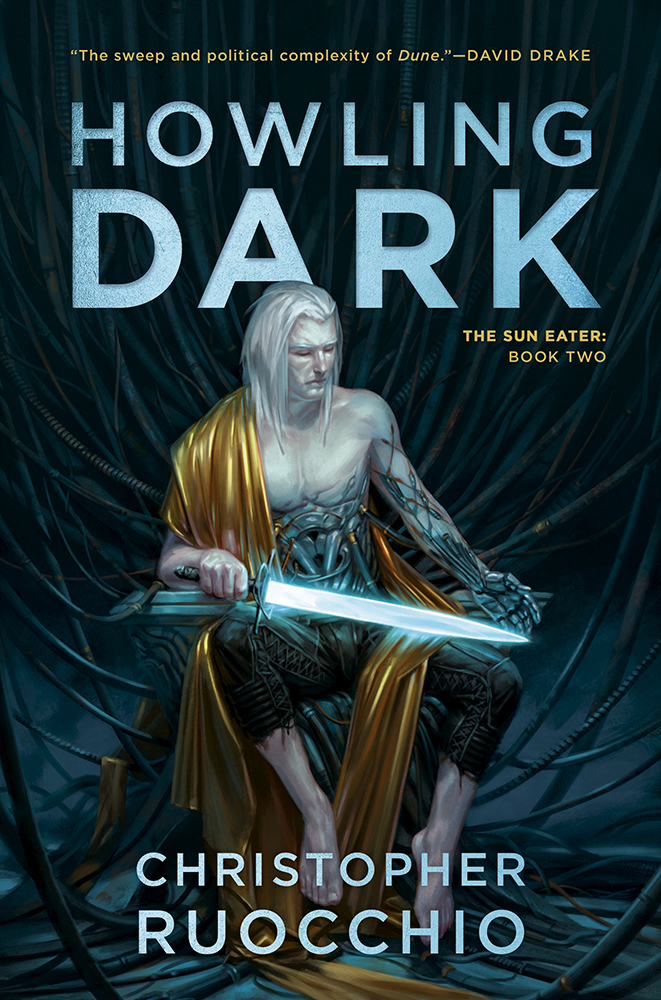
Alright folks, buckle up, because today we’re diving deep into Christopher Ruocchio’s Howling Dark, the second installment in the epic Sun Eater series! If you thought Empire of Silence was a wild ride, let me tell ya, Howling Dark cranks the grimdark space opera dial to eleven and then rips the knob off. This isn’t just a sequel; it’s an expansion of a universe that’s already breathtakingly vast and terrifyingly beautiful. So grab your void-coffee, get comfy, because we’re about to spoil the heck out of this beast of a book!
Plot Synopsis: Into the Howling Dark We Go! (MAJOR SPOILERS AHEAD!)
Okay, so after the galaxy-shattering events of Empire of Silence, our boy Hadrian Marlowe isn’t exactly chilling on a beach somewhere. Howling Dark picks up with Hadrian, now Lord Commandant of the mercenary Red Company, still on his galaxy-spanning, almost-suicidal quest to find the mythical Cielcin world of Vorgossos. Why? To somehow, someway, find a path to peace with the xenocidal aliens who are, you know, trying to eat humanity. No biggie.
The book kicks off with Hadrian being revived from cryonic fugue aboard his flagship, the Pharaoh. It’s been a cool six standard years since he was last conscious, but for the universe, it’s been much longer. The Red Company, a fragile alliance of Imperial legionnaires, Jaddian soldiers, and Norman mercenaries (including those picked up from the treacherous Emil Bordelon’s crew), is still a going concern, but tensions are high. Captain Bassander Lin, a by-the-book Imperial officer, is technically in command of the fleet but constantly clashes with Hadrian’s more unorthodox methods and goals. Lin thinks this whole Vorgossos chase is a waste of time while the Empire burns.
- The Lead on the Painted Man: The first major arc revolves around a lead on a mysterious arms dealer known as “The Painted Man,” supposedly a contact who can lead them to the Extrasolarians, and through them, to Vorgossos. This takes them to the planet Rustam, a world scarred by a recent Cielcin attack, where they land in the ramshackle, desperate city of Arslan, built from grounded starships. корабль The mission to find The Painted Man, led by Hadrian and his close companions like Switch, Ilex, and the Jaddian lieutenant Karim “Crim” Garone, goes sideways fast. The Painted Man turns out to be a terrifying, shapeshifting homunculus who knew Hadrian was coming. The meeting erupts into a chaotic firefight against “SOMs” – humans horrifically converted into machine-puppets. Tragically, Hadrian’s loyal myrmidon, Ghen, is killed in this ambush. Hadrian himself is captured by The Painted Man.
- Escape and a New Clue: Hadrian, ever the survivor, manages to turn the tables, killing The Painted Man and escaping with the alien’s personal data terminal. This terminal becomes the new MacGuffin, holding potential coordinates to Extrasolarian outposts, including the elusive March Station, which The Painted Man mentioned might be a stepping stone to Vorgossos. This partial victory comes at a heavy cost, deepening the rift between Hadrian and Lin, who sees this as further proof of Hadrian’s recklessness.
- The Council of Captains & The Breaking Point: Back on the Pharaoh, a tense council meeting reveals just how fractured the Red Company is. Lin, armed with new orders from the Imperial fleet to regroup at Coritani and news of another devastating Cielcin victory at Tyras, wants to abandon the Vorgossos quest. Otavia Corvo, the formidable Norman captain of the Mistral, refuses to take her ship and people into a direct Imperial war they didn’t sign up for, threatening to break her contract. Hadrian, presenting The Painted Man’s terminal, argues passionately to continue the mission. The real gut-punch comes when Jinan Azhar, Hadrian’s Jaddian captain and lover, sides with Lin, believing the quest has become too costly and that they should follow Imperial orders. This is a massive blow to Hadrian.
- The First Treason - A Desperate Gamble: Feeling betrayed and with his mission on the line, Hadrian makes a desperate choice. He secretly contacts Knight-Tribune Raine Smythe (his Imperial handler from Emesh) who, while unable to openly defy her superiors, gives Hadrian a clandestine order to continue his mission to Vorgossos, effectively taking the blame if he fails. Armed with this, Hadrian conspires with Otavia Corvo and Valka Onderra (who wants to study the Cielcin) to steal the Cielcin prisoner, Tanaran (a baetan priest-historian), from the Balmung (now under Jinan’s command) and defect with the Mistral.
- The Heist & The Second Treason: The plan to extract Tanaran is pure adrenaline. Valka uses her tech skills to disable cameras, while Hadrian, Switch, Crim, and Siran infiltrate the Balmung. They’re intercepted by Jinan’s first officer, Hanas, leading to a firefight. In a shocking twist, Pallino and Elara (Hadrian’s old myrmidon comrades) appear, having been recruited by Valka, and help them fight their way through. The escape culminates in a brutal sword fight between Hadrian and Bassander Lin on a catwalk. Hadrian wins, maiming Lin but sparing his life. As they escape in a shuttle, Jinan herself, heartbroken and furious, fires on them. OOF. This is the second treason – against his Imperial comrades and his lover.
- The Journey to the Enigma of Hours: With Tanaran (now awake and speaking some Galstani thanks to Valka), Hadrian, Valka, Otavia Corvo, and the loyal remnants of the Red Company (Pallino, Siran, Crim, Ilex) aboard the Mistral, they jump to the coordinates for March Station recovered from The Painted Man’s terminal. March Station is a massive, lawless ring-city in deep space, a hub for Extrasolarians, gene-hackers, and all sorts of dangerous elements. Hadrian, seeking passage to Vorgossos, is directed to a merchanter named Antonius Brevon. Brevon, a creepy old man with artificial eyes and a talking raven, confirms he can arrange passage to Vorgossos via an Exalted Sojourner ship, the Enigma of Hours, but the price is steep: either a massive sum of money or Hadrian’s palatine blood for “research.” Hadrian, disgusted, refuses to sell his own genes but, in a morally grey decision, offers a vial of Tanaran’s Cielcin blood instead. Brevon accepts.
- Aboard the Enigma of Hours: The Mistral is taken aboard the colossal, city-sized Exalted Sojourner, Enigma of Hours. The Exalted pilot, Nazzareno (a human consciousness in a terrifying spider-like machine body ), informs them the journey to Vorgossos will take only three weeks due to the Sojourner’s incredible FTL capabilities. The ship is a bizarre, dark, and ancient place.
- Vorgossos - The Dark World: They finally arrive at Vorgossos. It’s a frigid, lightless world orbiting a brown dwarf, with a single, impossibly tall hightower (space elevator) reaching into orbit. After a long descent, they find a dead, ancient city beneath a massive dome, lit by an artificial sun. The air smells of moss, and the architecture is cyclopean. There are SOM guards everywhere, their faces blurred, their wills not their own. Hadrian encounters Shara, a beggar who speaks of the Undying who rules Vorgossos, hinting he might be the legendary Kharn Sagara.
- The Audience with the Undying (Kharn Sagara): Hadrian is eventually summoned to Kharn Sagara’s throne room in an inverted pyramid at the bottom of the world. Sagara is an ancient, wizened man, kept alive by a tangle of machines, surrounded by floating eye-drones. He is indeed the Kharn Sagara of legend, fifteen thousand years old. Sagara is initially dismissive of Hadrian’s plea for help contacting Cielcin Prince Aranata Otiolo, stating he has traded with the Cielcin for centuries and won’t jeopardize his arrangements for the Empire. He knows Hadrian’s desire for peace is genuine but views the Empire as just another fleeting power.
- The Children of Saturn & The Garden: Hadrian, while waiting for Sagara to reconsider, is allowed to explore parts of the palace. He discovers a hidden, subterranean garden. He also stumbles upon a horrific nursery where Kharn Sagara grows clones of himself – children of various ages – to serve as his future hosts. He meets two of these children, Ren and Suzuha, who are disturbingly loyal to their “Father.” Suzuha reveals Sagara possesses ancient Mericanii weapons capable of “devouring stars.”
- Brethren - The Oracle in the Water: Drawn by visions, Hadrian, with Valka, finds a path to an underground sea. Here, he encounters Brethren, a colossal, ancient, and terrifying Mericanii AI composed of assimilated human neural tissue, a being of immense psychic power. Brethren reveals it has been expecting Hadrian, that he is “broken” (his past altered or obscured somehow), and that he is “the man to end it all.” It gives cryptic prophecies, speaks of “Leopards, Lions, and Wolves” (other great powers?), and states that the Cielcin Prince Aranata Otiolo is coming to Vorgossos. It also implies the Quiet (the ancient alien race whose ruins dot the galaxy) are not extinct and are manipulating events across time.
- The Third Treason - Lin’s Arrival: Just as Brethren delivers its most portentous warnings, Kharn Sagara confronts Hadrian, furious at his trespass. But before Sagara can act, Imperial ships appear! Bassander Lin, leading a small Imperial fleet including the Schiavona and Raine Smythe aboard the flagship Obdurate, has found Vorgossos. This is the third treason, but whose? It’s revealed that Switch, fearing for Hadrian’s safety and believing him mad, telegraphed their location to Lin, and Brethren allowed the message to get out.
- Showdown in the Garden & The Death of Kharn Sagara: A parley is arranged in the Garden between Sagara, Prince Aranata Otiolo (who has indeed arrived with his fleet), and Raine Smythe. The Cielcin are revealed to be even more barbaric than imagined, with Aranata using a mutilated human slave girl as a translator. Negotiations are impossible; Aranata understands only dominance and sees any offer of peace as submission. When Aranata brutally kills Imperial prisoners, including Sir William Crossflane, all hell breaks loose. Bassander Lin, acting on what he claims are orders from First Strategos Hauptmann (Smythe’s superior), assassinates Kharn Sagara, shooting him in the face with a disruptor!
- Chaos and a Miraculous Return: The death of Sagara plunges his SOM army into quiescence but also triggers the destruction of the Cielcin worldship Bahali imnal Akura by Hauptmann’s main fleet, which has also arrived. A desperate battle erupts in the Garden aboard the Demiurge (Sagara’s flagship). In the chaos, Aranata Otiolo, enraged, kills Hadrian, decapitating him with his own sword. Valka watches him die. Then, impossibly, Hadrian returns. He doesn’t know how, only that he was in a “howling dark” and then back, his severed right arm restored (though his left is now missing from the fight!). He finds himself guided by a vision of the Quiet (appearing as his old tutor, Gibson) and confronts Aranata again. This time, with the Cielcin forces decimated by the sudden failure of their nahute drones (thanks to Valka hacking their control frequency), Hadrian kills Prince Aranata Otiolo, avenging Smythe and Crossflane and ending the immediate threat.
- The Aftermath & The New Kharn: With Aranata dead and the Cielcin fleet shattered, the immediate battle is over. Kharn Sagara, however, isn’t truly gone. His consciousness transfers into both Ren and Suzuha, creating two new, younger, and potentially more volatile Undying rulers. They thank Hadrian for saving “them” (their lineage) and, as a sign of “gratitude,” provide him with a new, advanced prosthetic left arm.
- A New Name and a Summons: News of Hadrian’s “death” and “resurrection,” combined with his slaying of a Cielcin Prince, spreads. He is hailed as “Hadrian Halfmortal.” First Strategos Hauptmann reveals the attack was a calculated move to decapitate the Otiolo clan. For his “heroism,” Hadrian is awarded the Imperial Order of Merit and, shockingly, inducted into the elite Royal Victorian Knights. He receives a direct summons from Emperor William XXIII himself to attend upon him at Forum. Switch, consumed by guilt for his betrayal (which he believed was to save Hadrian), is exiled from Hadrian’s company. The book ends with Hadrian, Valka, and the loyal remnants of the Red Company (now including Pallino, Siran, Crim, and Ilex aboard the Imperial interceptor Schiavona) departing Vorgossos, bound for the heart of the Empire, leaving the two new Kharns and the mysteries of that dark world behind. What a cliffhanger!
**Character Analysis: Souls Forged in Fire **
Man, Ruocchio knows how to write characters you either root for, despise, or are just morbidly fascinated by.
- Hadrian Marlowe (The Halfmortal): Our protagonist goes through the absolute wringer. He starts burdened and ends… well, even more burdened but also legendary.
- Strengths: Unbreakable will (mostly), brilliant strategist when pushed, surprisingly compassionate despite his upbringing, and a swordsman of growing renown. His linguistic skills remain crucial.
- Flaws: Prone to brooding, can be reckless, carries immense guilt, and his idealism often clashes brutally with the galaxy’s realities. His relationship with Jinan shatters, which is a huge blow. His “death” and return leave him and everyone else questioning what he’s become.
- Arc: Hadrian’s journey here is about confronting the true cost of his quest. He makes morally grey choices (offering Tanaran’s blood, killing Nobuta) and faces devastating betrayals. His transformation into “Halfmortal” sets him on an even more extraordinary and terrifying path. His bond with Valka deepens significantly, shifting from intellectual respect to something much more profound, especially after Jinan’s betrayal.
- Valka Onderra Vhad Edda: Valka steps up big time in this book. She’s not just the scholar; she’s a survivor and a fierce ally.
- Arc: She moves from a somewhat detached observer to an active participant in Hadrian’s desperate gambits. Her loyalty to Hadrian becomes a cornerstone, especially after his “death.” Her tech skills are invaluable (disabling cameras, hacking nahute drones). We also get a glimpse into her past trauma (the Prachar terrorist incident), adding depth. Her horror at Sagara’s clone farm and her compassion for Hadrian are well-portrayed.
- Bassander Lin: Oh, Bassander. The by-the-book Imperial captain.
- Arc: Lin is Hadrian’s primary human antagonist for much of the book. He represents Imperial pragmatism versus Hadrian’s idealism. His decision to follow Hauptmann’s orders and assassinate Sagara is a pivotal moment, showcasing his unwavering loyalty to the Empire above all else, even his own tribune. His horrified reaction to Hadrian’s “resurrection” and subsequent near-worship is a fascinating turn. He’s a man broken by duty and perhaps, by the end, by awe.
- Jinan Azhar: This one hurt. Jinan’s arc is tragic.
- Arc: Her loyalty to Jadd and the Empire ultimately outweighs her love for Hadrian, leading to a painful betrayal. Her confrontation with Hadrian after he’s captured is raw and powerful. She chooses duty, and it costs her everything with him.
- Switch (William of Danu): Another tragic figure.
- Arc: Switch’s fear and desperation lead him to betray Hadrian, believing he’s saving him. The guilt consumes him. His exile is a poignant end to a long friendship, showing the devastating consequences of fear in a galaxy at war.
- Kharn Sagara (The Undying): What a villain! Or is he?
- Arc: The ancient lord of Vorgossos is a creature of immense power, intellect, and terrifying amorality. His methods (cloning, SOMs) are horrific. His “death” and subsequent “rebirth” into Ren and Suzuha create an even more unpredictable and dangerous entity (or entities). He’s less a simple antagonist and more a force of nature, a relic of a forgotten age.
- Prince Aranata Otiolo: A formidable, if short-lived, Cielcin antagonist.
- Arc: Represents the brutal, uncompromising nature of the Cielcin. His grief and rage upon Nobuta’s death are palpable, making him briefly, terrifyingly understandable before his own demise. His view of “peace as submission” highlights the chasm between human and Cielcin understanding.
**Thematic Resonance: Echoes in the Void **
Howling Dark isn’t just pew-pew lasers and alien guts (though there’s plenty of that!). It’s wrestling with some heavy themes:
- The Nature of Humanity and “The Other”: The Cielcin are truly alien, and the book constantly questions if peace is even possible. The Extrasolarians and Exalted push the boundaries of what it means to be human with their augmentations and societal structures. Is a human consciousness in a machine body still human? What about Kharn Sagara’s serial reincarnation?
- Betrayal and Loyalty: This theme is HUGE. Hadrian is betrayed by Jinan and Switch, his closest allies. He, in turn, betrays his Imperial orders (though sanctioned by Smythe). Loyalty is tested at every turn – to individuals, to factions, to ideals.
- The Cost of Knowledge and Power: The quest for Vorgossos, for understanding the Cielcin and the Quiet, comes at an immense personal and ethical cost for Hadrian. Kharn Sagara’s immortality is built on an unimaginable horror. Brethren’s vast knowledge is tied to its monstrous nature.
- Sacrifice and The Greater Good: Characters constantly make sacrifices. Smythe sacrifices her career (and ultimately her life) for the mission. Hadrian sacrifices relationships and his own morality. The Empire sacrifices twenty thousand colonists. Is it for a “greater good,” or just the rationale of those in power?
- The Burden of Command and Prophecy: Hadrian is increasingly burdened by responsibility and the weight of the prophecies surrounding him (“the man to end it all”). He’s no longer just a scholar or a reluctant warrior; he’s becoming a figure of legend, whether he likes it or not.
- Memory, History, and Identity: The Cielcin baetan Tanaran embodies the importance of history to his people. Kharn Sagara is living history. Hadrian’s own past is questioned (“broken,” according to Brethren). The theme of how memory shapes identity, and what happens when that identity is shattered or rebuilt, is potent.
**World-Building Deep Dive: A Universe of Wonders and Horrors **
Ruocchio’s world-building is top-tier, and Howling Dark expands it beautifully:
- The Sollan Empire: We see more of its ruthless pragmatism, its vast military machine (the Legions, the fleet under Hauptmann), and the precarious position of those like Smythe who dare to operate in the grey areas. The Chantry’s influence is ever-present, especially regarding forbidden tech like AI (daimon). The palatine class’s privileges and burdens are further explored through Hadrian’s unique position.
- The Cielcin: We get deeper insights into their society. The concept of the Aeta as a supreme leader, the scianda (clan-fleets), the different castes (scahari warriors, baetan priests), and their utterly alien mindset (peace as submission, the value of “property” over individuals). Their biology and culture remain deeply disturbing, especially their use of the human slave girl. The Bahali imnal Akura worldship is a terrifying testament to their power.
- Vorgossos: This legendary world is finally revealed, and it’s a masterpiece of grim, ancient horror. A dead world orbiting a brown dwarf, its impossibly tall hightower, the subterranean city, the inverted pyramid palace of Kharn Sagara, and the truly Lovecraftian underground sea where Brethren dwells. It feels ancient, predating humanity’s worst nightmares.
- Extrasolarian Space & March Station: March Station provides a glimpse into the lawless, vibrant, and dangerous cultures that exist outside Imperial control. Gene-modding, cybernetics, and black markets thrive. It’s a chaotic frontier.
- The Exalted & Technology: The Exalted, like Nazzareno and Calvert, showcase extreme human augmentation, blurring the line between man and machine. The Enigma of Hours Sojourner ship, with its city-sized interior and incredible FTL, hints at technologies far beyond Imperial understanding. Cryonic fugue, highmatter swords, phase disruptors, and Royse shields are standard SFF tech, but Sagara’s cloning tech and Brethren’s nature are on another level.
- The Quiet & Brethren: The mystery of the Quiet deepens. Brethren, a surviving Mericanii AI that has evolved into a psychic, biological-computational entity, is a standout creation. Its revelations about the Quiet’s influence and Hadrian’s altered past add a layer of cosmic horror and predestination.
- Lexicon/Dramatis Personae: The included glossary and character list are super helpful for keeping track of the myriad factions, titles, and alien terms, adding to the richness of the setting.
**Genre Context & Comparisons: Standing on the Shoulders of Giants (or Eating Them) **
Howling Dark firmly cements the Sun Eater series in the grand tradition of epic Space Opera with strong Military Sci-Fi and Grimdark Fantasy elements.
- Comparisons:
- Dune (Frank Herbert): The sense of ancient histories, powerful aristocratic houses, a protagonist grappling with a seemingly impossible destiny, and deep philosophical underpinnings definitely echo Dune. Vorgossos itself has a kind of Arrakis-like mythical status. Hadrian’s transformation and the prophecies surrounding him have a Paul Atreides vibe.
- Warhammer 40k: The sheer scale of the conflict, the grimness of the universe, the fanatical devotion (Imperial and Cielcin), and the presence of ancient, terrifying entities like Brethren and the Cielcin themselves definitely evoke the 40k universe. The Imperium of Man shares some thematic similarities with the Sollan Empire.
- The Book of the New Sun (Gene Wolfe): There’s a literary quality and a sense of deep, often obscure lore that reminds me of Wolfe. Hadrian, like Severian, is a narrator looking back on incredible and often traumatic events.
- Hyperion Cantos (Dan Simmons): The epic scope, the blending of far-future tech with almost mythological elements, and the journey into mysterious and dangerous territories.
- Originality vs. Tropes: Ruocchio masterfully uses established tropes (the reluctant hero, the ancient evil, the crumbling empire, the quest for a mythical place) but infuses them with fresh perspectives and a truly staggering level of detail. The Cielcin are a genuinely alien and terrifying antagonist race, not just humans with pointy ears. The blend of high-tech sci-fi with almost medieval/feudal societal structures is compelling.
**Influences & Inspirations: Echoes of the Past **
You can feel the weight of history and myth in Ruocchio’s writing:
- Classical Mythology & Literature: The chapter titles alone are a giveaway (“The Gates of Babylon,” “Tartarus,” “Saturn or Dis,” “Theseus Himself”). Hadrian’s journey often feels like a classical hero’s epic, fraught with trials, betrayals, and descents into the underworld (Vorgossos definitely qualifies!). The name “Anaxander” for Hadrian also evokes classical leadership.
- History (Roman Empire, Crusades): The structure and might of the Sollan Empire, with its Legions and complex bureaucracy, certainly draws from the Roman Empire. The war against the Cielcin has the feel of a long, brutal crusade against an “infidel” other.
- Gothic Literature & Cosmic Horror: The atmosphere of Vorgossos, the nature of Brethren, and the body horror associated with Kharn Sagara’s methods and the Cielcin’s slave-taking lean into Gothic and Lovecraftian horror. The sense of ancient, unknowable powers manipulating events is strong.
- Religious Texts & Themes: The quest for “peace,” the nature of “good vs. evil,” sacrifice, prophecy, and even “resurrection” (Hadrian’s return) are all deeply resonant with religious narratives. The Chantry acts as a powerful, dogmatic religious institution within the Empire.
**Key Takeaways **
If you walk away from Howling Dark with anything, it should be these:
- The Price of Peace is Unimaginably High: Hadrian’s quest is noble, but the sacrifices required are devastating, blurring moral lines.
- True Alien-ness is Terrifying: The Cielcin are not just misunderstood; their fundamental nature might be incompatible with human survival or understanding.
- The Past is Never Dead (and Might Eat You): Ancient technologies, AIs (Brethren), and beings (Kharn Sagara, the Quiet) have a profound and often horrific impact on the present.
- Loyalty is a Fragile Thing in a Galaxy at War: Friendships and loves are shattered under the immense pressures of duty, fear, and galactic conflict.
- Destiny is a Mofo: Hadrian is increasingly caught in a web of prophecy and manipulation by forces beyond his comprehension, questioning his own free will.
- The Universe is Wider and Weirder Than You Think: Vorgossos and the entities encountered there expand the scope of the Sun Eater universe into truly mind-bending territories.
**Wrapping It Up **
Phew! Howling Dark is an absolute monolith of a book, folks. It’s a brutal, beautiful, and utterly engrossing dive into a universe that feels both ancient and terrifyingly new. Ruocchio doesn’t pull any punches. The stakes are higher, the horrors are more visceral, and Hadrian Marlowe is dragged through hell and back (and then back to hell, just for good measure).
Is it a feel-good read? Heck no! This is grimdark space opera at its finest. But is it a compelling, thought-provoking, and epic read? Absolutely. If you loved Empire of Silence, you need to read Howling Dark. It takes everything that made the first book great and dials it up, expanding the lore, deepening the characters, and setting the stage for even greater conflicts to come.
Be warned: it will break your heart a few times, make you question everything, and leave you desperate for the next book. This is peak science fiction fantasy, and I am HERE FOR IT. Go read it! You won’t regret it (though your sleep schedule might).
Until next time, keep those pages turning!