Sword of Kaigen
Sword of Kaigen
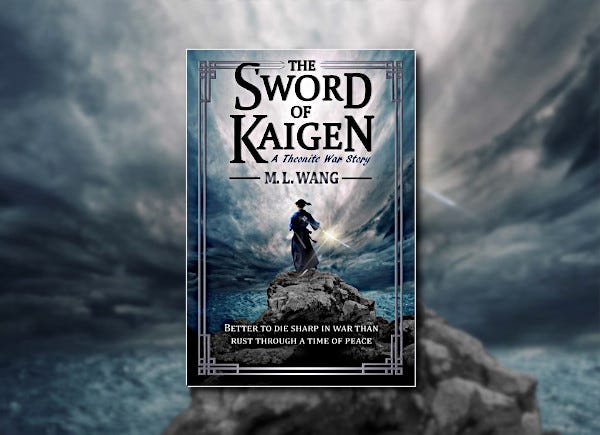
Alright, folks, gather ‘round the digital campfire because have I got a BOOK for you today! We’re diving deep into M.L. Wang’s standalone masterpiece, The Sword of Kaigen. If you haven’t heard of it, buckle up. If you have heard of it, you know you’re in for a treat (and maybe some emotional devastation, let’s be real). This isn’t just another fantasy novel; this is an experience. It’s got elemental magic, killer sword fights, cultural clashes, and characters that will absolutely wreck you in the best possible way.
So grab your tea (or something stronger), get comfy, and let’s talk about the icy, fiery, heart-wrenching world of The Sword of Kaigen. Full spoilers ahead, obviously – we’re dissecting this one!
Plot Synopsis: Hold Onto Your Hearts
Okay, deep breath. This story is primarily set on the Kusanagi Peninsula, the titular ‘Sword of Kaigen,’ a remote, icy province of the sprawling Kaigenese Empire on Planet Duna. This place is the shield against foreign threats, particularly the Ranganese Union across the sea. The warriors here, primarily the jijaka (water/ice manipulators), are legendary, steeped in tradition and a fierce code of honor. They believe themselves to be the pinnacle of martial prowess, descended from gods, the unbreakable sword defending the Empire.
Our initial focus is on Matsuda Mamoru , the teenage son of the current Matsuda patriarch, Takeru. The Matsudas are the family, masters of the legendary Whispering Blade technique – ice sharp enough to cut steel. Mamoru is talented, earnest, maybe a bit naive, and feels the immense pressure of his lineage. He attends Kumono Academy, a high school literally carved into a mountain monastery (because of course it is), accessible only by a treacherous climb. Early on, he meets Kwang Chul-hee , a transfer student from the more modern northern parts of the Empire. Kwang is immediately out of place with his city ways, modern tech (an info-com! ), and, crucially, his different perspective on Kaigenese history and the Empire’s propaganda.
The Setting:
We’re immediately immersed in the isolation and harsh beauty of Takayubi village on Mt. Takayubi. The climb to school establishes the physical and metaphorical difficulty of life here.
The Culture Clash:
Kwang’s arrival throws the local Kaigenese beliefs into sharp relief. He questions the official history, particularly the narrative surrounding the last great war (the Keleba) and the supposed invincibility of Kaigenese warriors against the Ranganese. This immediately creates friction with the proud, traditionalist Mamoru and his friends.
Parallel to Mamoru’s story, we get the perspective of his mother, Matsuda Misaki. On the surface, she’s the perfect Kaigenese noblewoman: dutiful wife, mother of four sons (Mamoru, Hiroshi, Nagasa, and baby Izumo), skilled in domestic arts. BUT WAIT, THERE’S MORE. Misaki has a past she keeps buried deeper than the winter snows. She wasn’t born in Takayubi; she grew up far away, attended an international theonite academy (Daybreak in Carytha – gasp!), and was once a highly skilled combatant known as Sirawu, the Shadow. She fought alongside friends like Robin Thundyil (Firebird) and Elleen Elden (Whitewing) in the rough streets of Livingston. She married Takeru in an arranged match, burying her past, her skills, and her true self to fit the rigid mold expected of her. Her relationship with her husband, Matsuda Takeru , is cold, distant, and defined by duty rather than affection. Her closest confidantes are her sister-in-law, Setsuko (wife of Takeru’s more outgoing brother, Takashi), a warm, down-to-earth fisherwoman, and Hyori , the gentle wife of Yukino Dai, Kumono Academy’s swordmaster.
Misaki’s Secret:
This is HUGE. Her hidden past and suppressed abilities form the emotional core of the story. Her quiet life is a cage she built for herself.
Takeru’s Coldness:
The patriarch is a master of the Whispering Blade but emotionally impenetrable, seemingly valuing duty and strength above all else, especially connection.
The tension builds as Kwang continues to poke holes in the Imperial narrative Mamoru holds dear. He reveals evidence suggesting the Empire covered up massive casualties and reliance on foreign (Yammanka) aid during the Keleba, contradicting the local legends of Kaigenese dominance. Mamoru struggles with this cognitive dissonance, leading to a physical altercation where he injures Kwang, earning them both punishment: cleaning the icy temple roof. This forced proximity deepens their complicated relationship, with Mamoru torn between ingrained loyalty and the disturbing evidence Kwang presents (including finding a wrecked Yammanka jet, not Kaigenese, hidden on the mountain, containing a pilot’s skeleton).
Then, disaster strikes. Hard. Misaki receives a letter from her brother, Kazu, Lord of the Arashiki Stormfort in Ishihama, warning of devastating coastal “storms.” Simultaneously, Takeru gets word of something serious requiring his attention. While the village buzzes with unease, the true horror arrives: a massive, unnatural tornado, clearly wielded by powerful fonyaka (air manipulators), descends upon the coast.
The Invasion:
The Ranganese attack isn’t a conventional assault; it begins with elemental fury. The tornado obliterates the fishing village at the base of the mountain, killing Setsuko’s family and countless others in an instant. The raw grief and shock are palpable.
Setsuko’s Grief:
Her reaction to the destruction of her home and family is visceral and heartbreaking, establishing the immediate, devastating cost of this conflict.
The tornado then climbs the mountain – something thought impossible – and destroys the western village, home to Mamoru’s friends Itsuki and Yuuta, and Hyori’s family. The warriors of the old village, led by Matsuda Takashi (Takeru’s brother, the head of the house and Kumono headmaster), Takeru, Mamoru, and Yukino Dai, race to defend the pass – the last line of defense for the remaining village and the Matsuda compound.
What follows is one of the most intense, brutal, and brilliantly depicted fantasy battles I’ve ever read. The twelve defenders face hundreds of Ranganese soldiers. Takashi, a force of nature, unleashes devastating ice attacks but is clearly outmatched. Tou-sama (Takeru) displays incredible precision, taking out key targets. Yukino Dai showcases blinding speed with his katana. Mamoru, initially frozen by fear and the horrific reality of war, finds his footing, combining his power with Yukino Sensei’s guidance.
The Defense:
The fight at the pass is desperate and harrowing. The jijaka use everything they have against overwhelming odds. The descriptions are visceral, highlighting the power and the terrible cost.
The Matsuda Dragon:
Takeru and Takashi combine their powers to form a colossal ice dragon – a legendary technique showcasing the pinnacle of Matsuda power, but even this isn’t enough against the most elite Ranganese fighters.
The Sacrifices:
The defense is heroic but ultimately unsustainable. Key figures fall. Yukino Dai is killed by a shockingly skilled fonyaka warrior (the “dragon killer”). Takashi, mortally wounded, unleashes his dying jiya in a spectacular, terrifying explosion of ice, taking numerous enemies with him.
With the line collapsing, Takashi orders Takeru back to protect the women and children, leaving Mamoru as the last Matsuda defender. Mamoru, facing the seemingly unstoppable dragon killer, has a moment of profound realization and taps into the true depth of his Matsuda heritage, forming his own Whispering Blade for the first and last time. He kills the dragon killer but is mortally wounded in the process, dying alone on the snow-covered battlefield as the Imperial airstrike finally begins overhead (called in by Kwang using his info-com).
Mamoru’s Ascension & Death:
This is the climax of Mamoru’s arc. He achieves the legendary technique in his final moments, fulfilling his duty but dying tragically young. His final thoughts are heartbreakingly simple.
The Airstrike & Cover-Up:
The Imperial forces (and their Yammanka allies) arrive after the local fighters have broken the back of the assault. Their involvement is less about rescue and more about containing the situation and enforcing the Emperor’s narrative. They bomb the area indiscriminately and later burn all the bodies (Kaigenese and Ranganese) in a mass pyre, officially declaring the event a natural disaster to hide the Empire’s weakness and the true strength of the Ranganese.
Back at the Matsuda compound, Misaki, having learned of the Ranganese soldiers breaking through the northern pass, has armed herself with Siradenyaa , the obsidian sword hidden under her kitchen floorboards (a gift from her inventor friend Koli Kuruma). She single-handedly kills multiple Ranganese soldiers who breach the compound, showcasing the deadly skills she’d kept hidden for fifteen years. She saves Setsuko and the children but is nearly killed herself by the last attacker, only to be saved by five-year-old Hiroshi , who takes up Siradenyaa and kills the man with chilling Matsuda precision.
Misaki Unleashed:
Witnessing Misaki finally drop the housewife facade and become the Shadow again is breathtaking and terrifying. Her efficiency is brutal.
Hiroshi’s Action:
This is a shocking and deeply disturbing moment, highlighting the inherited trauma and burden of the Matsuda line.
In the aftermath, Takayubi is decimated. Takeru, now the Matsuda patriarch, must lead the survivors. The Imperial government offers no real aid, only enforcing the official lie. Misaki confronts Takeru about his failings – his coldness, his abandonment of Mamoru at the pass, his inability to stand up to the Empire. In a raw, emotional exchange, Takeru reveals his own deep-seated pain and the coping mechanisms (detaching himself by “becoming the mountain”) he’s used since childhood. He admits his failures and, crucially, accepts Misaki not just as his wife, but as an equal, a warrior whose strength he needs. They finally connect, finding a path forward together. Misaki, having faced her past and her present, finds a measure of peace and purpose in rebuilding Takayubi and raising her remaining sons, finally embracing her full identity. The ending sees them beginning the slow process of healing and rebuilding, forever changed but resolute, with the knowledge that the Empire is not what they thought, and their true strength lies within their own community. The very final chapter jumps slightly ahead, showing Robin Thundyil visiting Misaki years later, revealing details about his own life and the larger, ominous plots involving the mysterious figure behind the gray cloaks and kidnapped theonite children, tying the standalone into the broader Theonite series.
Character Analysis: Broken and Rebuilt
Where do I even start? The characters in The Sword of Kaigen are the pulsing, bleeding heart of this story.
Misaki Matsuda (Sirawu):
Oh, Misaki. She’s the undeniable core of the novel. Her journey is devastatingly brilliant. We see her trapped in a life that demands she stifle everything she once was – a skilled fighter, an independent thinker. She’s brittle, often resentful, but possesses immense inner strength (and literal strength). Her transformation back into the warrior, forced by tragedy, is both terrifying and cathartic. Her arc explores motherhood, duty, identity, and the crushing weight of societal expectations. Her final acceptance of Takeru, not as a replacement for her past love but as the partner she needs now , is incredibly mature and moving. She’s flawed, fierce, and unforgettable.
Mamoru Matsuda:
The tragic hero. He starts as the idealistic son, desperate to live up to the Matsuda name. His journey is one of rapid, brutal disillusionment as he confronts the lies of the Empire and the complexities of the world beyond Takayubi. He grapples with fear, duty, and the terrifying power within him. His mastery of the Whispering Blade at the very end is a moment of pure, heartbreaking triumph before his death. He represents the potential and the sacrifice of the young generation.
Takeru Matsuda:
The Ice Man himself. For most of the book, he’s infuriatingly stoic, cold, and seemingly unfeeling. He embodies the rigid, emotionally repressed hyper-masculinity of old Kaigen. His “become the mountain” reveal is fascinating, explaining his detachment as a coping mechanism born of childhood trauma. His eventual breakdown after Mamoru’s death and his acceptance of Misaki as an equal signifies a massive, hard-won shift. He’s a complex figure – not easily likable, but understandable by the end.
Takashi Matsuda:
Takeru’s older brother is his foil. Where Takeru is ice, Takashi is fire (metaphorically, he’s still a jijaka!). He’s passionate, loves openly (especially Setsuko), leads with charisma, and embraces the glory of battle. His death is a huge blow, representing the loss of a different kind of Matsuda strength – one less controlled, perhaps, but full of life.
Setsuko Matsuda:
The heart and earthy wisdom of the family. Her journey from cheerful fisherwoman to grieving widow and pillar of strength for the community is grounding. She provides warmth, humour, and crucial emotional support, especially for Misaki. Her resilience is remarkable.
Kwang Chul-hee:
The catalyst. As the outsider, he introduces the conflicting narratives and forces Mamoru (and the reader) to question the status quo. He represents the modern Empire and the world beyond Takayubi’s bubble. His perspective is vital, even if he’s often out of his depth physically.
The relationships are just chef’s kiss. Misaki and Takeru’s journey from cold duty to fragile understanding is central. Misaki’s bond with Setsuko is a lifeline. Mamoru’s relationships with his parents are fraught with expectation and unspoken feelings. Every interaction feels weighted and real.
Thematic Resonance: Duty, Lies, and the Scars of War
This book isn’t just swords and ice magic, oh no. It digs deep.
Duty vs. Self:
This is huge, especially for Misaki and Takeru. What does it mean to fulfill your duty to family, tradition, and country, especially when it costs you your identity or happiness? The book explores the immense, often crushing weight of expectation.
Truth vs. Propaganda:
The Empire’s carefully crafted lies versus the messy, brutal reality of history and war is a major driving force. Kwang introduces this, but the Ranganese attack and the Imperial cover-up shatter the illusion for everyone. It forces characters and readers to question narratives they took for granted.
Trauma & Sacrifice:
The cost of war isn’t just measured in lives lost, but in the deep scars left on survivors – physical, emotional, and societal. The book doesn’t shy away from the brutality and the lingering effects of violence and loss. Sacrifice is portrayed as both heroic (Mamoru, Takashi) and devastatingly costly.
Motherhood & Identity:
Misaki’s struggle is deeply tied to her role as a mother. Is she the dutiful Matsuda wife, or Sirawu the Shadow? Can she be both? The novel offers a powerful, nuanced look at the sacrifices and unexpected strengths found in motherhood, particularly in a restrictive, patriarchal society.
Tradition vs. Modernity:
Takayubi is a pocket of the past, clashing with the encroaching modern world represented by Kwang, the info-coms, and eventually, the hard truths of the Empire’s current state. The story questions the value and the danger of clinging too tightly to tradition.
World-Building Deep Dive: Icy Peaks and Hidden Depths
M.L. Wang builds a world that feels both epic and intimate.
Planet Duna & Kaigen:
We get glimpses of a larger world (Planet Duna) with diverse nations (Kaigen, Yamma, Ranga, Sizwe, Hades, Abiria, Carytha) and complex geopolitics. The focus, however, is laser-sharp on the Kaigenese Empire, specifically the province of Shirojima and the Kusanagi Peninsula.
The Sword of Kaigen:
The peninsula itself is a character – harsh, isolated, beautiful, demanding. Its geography directly impacts the culture and the plot (the defensible passes, the isolation). Mt. Takayubi, Kumono Lake, the different villages – all feel distinct and lived-in.
Magic System (Theonites):
It’s elemental and tied to specific peoples. Jijaka (water/ice - Kaigenese focus), Fonyaka (air - Ranganese focus), Tajaka (fire - Yammanka focus). There are also sub-theonites like littigi (light manipulators). Power levels vary, and crucially, there are bloodline techniques like the Matsuda’s Whispering Blade (Sasayaiba) and the Tsusano’s (Misaki’s family) implied blood manipulation (Blood Needle). This system is integral to the combat and the societal structure.
Society & Culture:
Kaigenese society, particularly in Takayubi, is deeply traditional, hierarchical (based on the kafonu system of occupational classes like koro warriors, numu smiths, fina priests, jaseli loremasters), and patriarchal. Duty, honor, and lineage are paramount. This contrasts sharply with the implied modernity elsewhere and the different cultural norms Kwang brings. The Ryuhon Falleya religion, with its ocean gods Nagi and Nami, also shapes their worldview, distinct from the more widespread Nagino Falleya.
History & Politics:
The legacy of the Keleba war hangs heavy. The relationship between the Kaigenese Empire, the Ranganese Union, and the Yammanka Alliance is complex and fraught with tension and manipulation, revealed brilliantly through the plot. The Empire’s use of propaganda is a key world-building element that drives the conflict.
Genre Context & Comparisons: Familiar Blades, Fresh Cuts
The Sword of Kaigen sits interestingly within the fantasy genre.
Subgenre Blend:
It’s definitely got Military Fantasy vibes with the focus on warriors, duty, and epic battles. There are touches of Grimdark in its brutal honesty about the costs of war and trauma, but it retains a core of hope and character resilience that pushes it away from nihilism. It’s profoundly Character-Driven Fantasy at its heart.
Emotional Core:
Like authors such as Robin Hobb, Wang prioritizes deep emotional exploration and complex character relationships amidst the high-stakes action. The internal struggles are just as important, if not more so, than the external battles.
Cultural Specificity:
It stands out with its heavily Japanese-inspired setting and culture, blended with hints of other Asian and African influences (particularly in naming conventions and potentially the wider world beyond Kaigen). This offers a refreshing perspective compared to the often Euro-centric default in fantasy.
Tropes & Originality:
It uses familiar tropes (isolated warrior culture, legendary bloodline powers, hidden pasts) but executes them with such depth and nuance that they feel fresh. The specific blend of elemental magic, cultural detail, and intense emotional focus feels highly original. The focus on a middle-aged mother as a central protagonist is also a welcome departure from typical fantasy fare.
Influences & Inspirations: Echoes of Steel and Spirit
While only M.L. Wang knows for sure, we can speculate!
East Asian History/Culture:
The most obvious influence. Samurai codes of honor, Bushido-like ideals (though explored critically), Japanese/Korean naming conventions, social structures, aesthetics (kimono, hakama, katana, architecture) are all deeply woven into the fabric of Kaigen.
Anime/Manga:
The pacing and style of the action sequences, particularly the focus on specific, named techniques (Whispering Blade, Blood Needle) and the sheer intensity of the elemental magic duels, feel reminiscent of high-action Shonen or Seinen anime/manga. The emotional intensity also shares some DNA with these mediums.
Modern Geopolitics/History:
The themes of propaganda, government cover-ups, the complexities of alliances, and the devastating impact of war on civilians resonate with real-world historical and ongoing conflicts. There’s a subtle commentary on nationalism and the manipulation of history.
Character-Focused Fantasy:
As mentioned, echoes of authors who prioritize deep character work like Robin Hobb or Guy Gavriel Kay might be present in the approach to weaving personal struggles with epic events.
Key Takeaways
- Emotional Gut-Punch: This book will make you feel things. Deeply. Be prepared.
- Misaki is Queen: Her journey is one of the most compelling and well-executed character arcs in modern fantasy.
- The Cost of Duty: Explores the heavy, often devastating, price of upholding tradition and societal expectations.
- World-Building Matters: The specific culture and setting of Kaigen aren’t just background; they are integral to the plot and character motivations.
- Brutal Action, Intimate Stakes: Masterfully blends large-scale, high-octane battles with intensely personal emotional conflicts.
- Question Everything: Challenges readers to think critically about honour, truth, propaganda, and sacrifice.
- Standalone Power: While part of a wider world, it tells a complete, powerful, and satisfying story on its own.
Wrapping It Up
Wow. Just… wow. The Sword of Kaigen is an absolute triumph. It’s the kind of book that stays with you long after you finish the last page. It’s brutal, beautiful, heartbreaking, and ultimately, hopeful. M.L. Wang delivers stunning action, a meticulously crafted world, and characters so real you’ll ache for them. Misaki’s story alone is worth the price of admission, but the entire package is just phenomenal. If you’re looking for fantasy that digs deep, challenges you, makes you cry, and leaves you breathless, you need to read this book. It’s easily one of the best standalones the genre has produced in years. Go get it. Seriously. You won’t regret it (though your tear ducts might!).