The Gunslinger
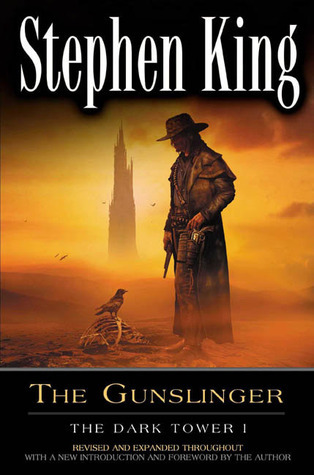
Alright folks! Buckle up, because we’re diving into the absolute beginning of one of the wildest, most unique journeys in fantasy literature: Stephen King’s The Gunslinger. This book is less a traditional fantasy epic and more like a fever dream painted across a post-apocalyptic Western landscape, and honestly, it’s just so cool. If you’re looking for something that scratches that fantasy itch but feels completely fresh, this is it. Let’s break it down!
Plot Synopsis 🗺️✨
Alright, so The Gunslinger kicks off in media res with perhaps one of the most iconic opening lines ever: “The man in black fled across the desert, and the gunslinger followed.” Simple, evocative, and sets the entire tone. We meet Roland Deschain, our protagonist, a laconic, solitary figure in a desolate, sprawling desert. He’s been chasing this “man in black” for ages, and this book is the first chapter of that relentless pursuit.
The desert itself is almost a character – vast, punishing, and seemingly endless. Roland is just walking, following the man in black’s trail marked by… well, not much. A few cold campfires, strange ideograms burned into the earth – signs that the man in black is deliberate and perhaps knows Roland is following. Roland is incredibly tough, almost inhumanly so, adapted to this brutal environment. He’s got his father’s guns, weighted just right, and a singleminded purpose that borders on obsession.
His journey takes him through the remnants of what was once a more civilized world, now mostly fallen into decay and weirdness. His first significant stop is the town of Tull. Now, Tull is… a whole situation. It’s a remote, insular place, mostly populated by rough people, some of whom are “weed-eaters” – addicted to devil-grass, a potent, reality-distorting drug. Roland arrives at night, drawn by the sound of a honky-tonk piano. He goes into the local bar (Sheb’s) looking for food and information.
He meets Allie, the barwoman, who’s seen better days (haven’t they all in this world?). He also encounters Nort, a deeply disturbed man who looks like he should be dead, chewing devil-grass and speaking in fragmented, horrifying pronouncements. Roland feels a pull towards Allie, an almost absentminded affection, despite her rough edges.
He finds out from Allie that the man in black passed through Tull not long ago and did something… unnatural. He brought Nort back to life after the man had died publicly in front of the bar. This act of resurrection, seemingly a miracle, deeply unsettled the town and drove Nort even further into madness, leaving him reliant on the weed just to function semi-coherently. The man in black also left Allie a strange, folded piece of paper with a single word written on it: “NINETEEN”. The note claimed that if she said this word to Nort, his mind would be opened, and he would reveal the secrets of death and beyond. The note tantalizingly suggested she wouldn’t be able to resist asking, even if she knew it would drive her mad.
Roland stays with Allie for a few days, a strange interlude of domesticity in his harsh quest. He tries to warn Allie away from the word “nineteen”, understanding it’s a trap. He also visits the local church and sees Sylvia Pittston, a fanatical preacher woman who whips the townsfolk into a frenzy talking about “The Interloper” and the coming “Last Times.” Roland senses the man in black’s influence here too, seeing that Sylvia is likely possessed by a demon, or at least profoundly manipulated. He confronts her, pressing for information about what lies beyond the desert mountains the man in black is heading towards. She resists, but under duress (Roland gets… physical), she reveals he is going to the mountains to “make his strength” and practice “meditation”. She also calls Roland “The Antichrist” and claims the man in black impregnated her with the child of a “great king” (which Roland dismisses as demonic influence).
Returning to town, Roland senses the trap is closing. The townsfolk, riled up by Sylvia Pittston and terrified/fascinated by Nort’s unnatural state and Roland’s presence, are turning against him. Allie, unable to resist the temptation of knowing, finally whispers the word “nineteen” to Nort, who in turn reveals horrific truths about death. Driven mad by the knowledge, Allie leads the townsfolk in a mob attack on Roland, using Nort as a human shield.
The climax in Tull is brutal and swift. Roland, relying purely on instinct and his highly-trained gunslinging reflexes, kills everyone in the town who attacks him. Men, women, even children tagging along – they fall before his guns. Allie dies by his hand, begging him to kill her after saying the word “nineteen.” It’s a massacre, a horrifying demonstration of Roland’s deadly skill and the terrible cost of his quest. He walks away from the dead town, mounts his mule, and heads back into the desert.
He continues across the desert, a long, grueling stretch of time. He stops at a remote dweller’s hut and talks to a man named Brown, who has a talking raven named Zoltan. Brown is surprisingly sane and gives Roland some food and water. Brown also confirms the man in black passed by weeks ago and asked similar questions about the land and time. This stop is brief, another isolated point on Roland’s journey.
Eventually, utterly dehydrated and near death, Roland stumbles upon an abandoned Way Station. He expects to find the man in black, but instead finds a young boy named Jake. Jake appears out of nowhere in this impossible location. Roland, weakened by sunstroke, collapses.
When he recovers, Jake is there, having cared for him. Jake seems to have lost his memory of how he got there or much of his past life, which he describes as being from a bustling city with tall buildings and cars (a stark contrast to Roland’s world, implicitly suggesting a connection to our reality). Jake is frightened and confused, his only measurement of time being the number of times he’s “pooped”.
Roland realizes Jake is another piece of the puzzle placed by the man in black. Using a strange mental trick (perhaps a mild form of telepathy or hypnosis combined with a visual focus on a bullet), Roland enters Jake’s mind and sees a fragmented vision of the boy’s death: being pushed into the street in front of a car by a figure implied to be the man in black. Jake then just… was at the Way Station.
Despite his initial suspicion and the Oracle’s later warning that Jake is a “gate” to the man in black and that while they travel together, the man in black has Roland’s “soul in his pocket,” Roland feels a connection to the boy. He decides he cannot leave Jake behind in this desolate place. They will travel together.
Before leaving the Way Station, Roland discovers an ancient, working water pump powered by some forgotten technology (marked “North Central Positronics”). He also finds a basement where, upon investigation, he hears a “speaking-demon” from within the wall. It sounds like Allie’s voice and warns him about the man in black having his soul and hints about Roland needing to draw “the three.” Roland, following an ancient custom, puts his hand through the wall and pulls out a jawbone, implied to be the physical remnant of the demon’s host, which he keeps.
Their journey takes them towards the mountains the man in black has entered. Roland begins to feel affection for the boy, despite his reservations and the Oracle’s ominous prophecy. Jake proves surprisingly resilient and capable, even helping Roland climb difficult sections.
During a rest stop in the foothills, Roland takes a drug (mescaline, from a pill he’s been carrying) and visits a circle of standing stones nearby – the lair of the Oracle the “speaking-demon” mentioned. He undergoes a hallucinatory experience, seemingly coupling with the formless spirit of the Oracle, who gives him fragmented prophecies. She confirms he must draw “the three” and suggests one is a young, dark-haired man infested with “HEROIN”, another “comes on wheels,” and the third is “Death… but not for you.” She also states the man in black is nearby and they will speak of the Tower. Most disturbingly, she confirms Jake is his “gate” to the man in black and his way to the three, and that Roland can spare the boy only if he turns back from his quest entirely and heads northwest. Sworn by his father’s guns, Roland refuses, implicitly choosing his quest over the boy’s life.
They press on into the mountains. They discover an ancient, underground railway system and a working handcar. The journey through the lightless tunnels is long and arduous, but the handcar speeds their progress. They encounter “Slow Mutants,” devolved, glowing, grotesque humanoids who attack them. Roland defends them both, killing several, but they are only stopped by rocks placed on the track.
At the end of the tunnels, they reach a vast, underground terminal (“TRACK 10 TO SURFACE AND POINTS WEST”). It’s filled with silent, empty trains and mummified figures from the lost world. The boy refuses to go further, knowing Roland will sacrifice him to catch the man in black, and begs Roland to leave him there. Roland, torn but determined, feigns leaving the boy, starting the handcar. Jake, terrified of being alone and knowing Roland is his only hope, leaps back onto the handcar.
The tracks lead out over a dizzying, rotten trestle spanning a deep chasm with the thundering underground river far below. They must walk across it. The trestle is collapsing around them, ties giving way. As they near the end, a silhouette blocks the light – the man in black. He calls out to Roland, telling him the “games” are over and inviting him across, adding “Just the two of us.”
As the trestle gives way beneath him, Jake dangles over the abyss, calling for Roland to help him. The man in black urges Roland to cross. In the ultimate, heartbreaking sacrifice, Roland leaps across the collapsing section towards the man in black and the light, leaving Jake to fall into the darkness. Jake’s last words are “Go then. There are other worlds than these.”
Roland scrambles onto the solid rock on the other side, utterly spent. The man in black is there, laughing, calling Roland’s action progress and admitting they make “great magic” together. Roland empties his guns at him, but the bullets pass through the man in black harmlessly. The man in black invites Roland to sit and talk, promising a long “palaver” about the Tower.
The final section details Roland’s conversation with the man in black, which lasts for a supernaturally long night. The man in black explains the nature of the Tower (the nexus of existence, size, and time), the concept of universes within universes, and implies Roland got a terrifying glimpse of this truth during his vision with the Oracle (the blade of grass being their entire universe). He reveals he is a minion of a “red king” who now rules the Tower, but claims he doesn’t know the king’s name or even his own ultimate purpose, only that he is Roland’s “apotheosis” and “climax.” He shows Roland Tarot-like cards representing the Hanged Man (Roland), the Sailor (Jake), the Prisoner (someone afflicted by Heroin, one of the three Roland must draw), the Lady of Shadows (implying someone two-faced or deceptive, possibly another of the three), Death (not for Roland), and the Tower (Roland’s goal). The seventh card, Life, is not for Roland, and its place in the pattern is not revealed.
The man in black tells Roland to go west to the sea to begin the process of “drawing” the three. He also reveals that he is Marten, the gunslinger’s father’s counselor and his mother’s lover, confirming Roland’s long-held suspicion and the root of his trauma. He admits he manipulated events (like driving Roland to challenge Cort early) and set the trap in Tull.
As dawn approaches, the man in black ends the palaver, declaring his part is done. He gives Roland a final gift of tobacco and uses his power to make Roland sleep.
When Roland wakes up, he finds ten years have passed. His hair is graying, and his face is lined. The man in black is a skeleton beside the dead campfire, turned to dust. Roland takes the jawbone of the skeleton, replacing the one lost. He stands, now older and even more weathered, and begins walking west, towards the sea, towards the next stage of his quest, mourning the loss of Jake.
Character Analysis
- Roland Deschain: Our protagonist. He is defined by his relentless quest for the Dark Tower.
- Strengths: Incredibly skilled gunman, resilient, adaptable, focused, has a strong sense of duty (though its object shifts), and possesses a powerful, tenacious will.
- Flaws: Emotionally distant, capable of ruthless sacrifice (most notably Jake), haunted by his past (especially his mother, Marten, and Susan), often driven by instinct rather than conscious thought. His singular focus makes him difficult to connect with, both for other characters and potentially the reader initially.
- Arc (Subtle): While his external quest is linear, internally he grapples with the cost of his journey and the sacrifices required. His relationship with Jake is the most significant emotional development, forcing him to confront his humanity and the price of his obsession.
- The Man in Black (Walter o’ Dim / Marten): The enigmatic antagonist, seemingly a sorcerer or powerful agent.
- Nature: Mysterious, manipulative, possesses strange powers (illusions, regeneration, possible time distortion, prophecy), and seems to know more about Roland and the Tower than anyone else. He is cruel, sarcastic, and seems to delight in tormenting Roland.
- Motivation: Explicitly states he is a minion of a “red king” at the Tower. His immediate motivation seems to be guiding (or perhaps testing and breaking) Roland for his master’s purposes, and to settle old scores (implied from his past as Marten).
- Impact: He is the driving force of the plot, always just ahead of Roland, leaving traps and clues. His revelations about Roland’s past and the nature of the universe are crucial to understanding the wider scope of the series.
- Jake Chambers: The boy Roland finds at the Way Station.
- Nature: Innocent, confused, resilient, perceptive, possesses a mysterious connection to another world (implied to be ours) and potentially psychic abilities (“the touch”).
- Role: He serves as a moral compass, a temporary companion who brings out Roland’s buried humanity and affection, and ultimately, a tragic sacrifice that propels Roland forward and highlights the brutal cost of his quest. He is defined as Roland’s “gate” to the next stage.
- Alice: The barwoman in Tull. Represents the fallen state of the world and the ordinary people caught in its decay. Her desire for knowledge and eventual madness (fueled by the man in black’s trap) serve as a micro-example of the broader themes of decay and forbidden truth.
- Nort: The weed-eater resurrected by the man in black. Represents the grotesque and unnatural consequences of the man in black’s power and the breakdown of the natural order.
- Sylvia Pittston: The fanatical preacher. Represents the twisted and destructive forms that belief and manipulation can take in this fallen world.
Thematic Resonance
- The Relentless Quest vs. Humanity: The core tension. Roland is defined by his pursuit of the Tower, often sacrificing everything (and everyone) for it. The book constantly questions the value of this quest when it leads to such death and isolation, particularly highlighted by the relationship with Jake. Can the goal justify the means?
- The Fall of Civilization / The World Has Moved On: The setting is a character in itself, a decayed reflection of a once-great civilization. This theme is shown through ruined buildings, forgotten technology, devolved people (Slow Mutants, weed-eaters), and a general sense of entropy and decay. The past (Gilead, Roland’s training, even Jake’s world) is presented as something lost and often distorted by memory.
- Fate, Destiny, and Ka: The concept of “ka” (a powerful, often cruel form of destiny) permeates the story. Events feel predetermined – Roland must follow the man in black, Jake must be sacrificed. Characters often speak as if their actions are mandated by some unseen force.
- Good vs. Evil (Ambiguous): While the man in black is clearly antagonistic, the nature of good and evil is murky. Roland commits horrific acts (the Tull massacre) in pursuit of his goal, which may or may not be “good.” The Tower itself is presented as a mysterious, potentially dangerous goal, not necessarily a purely benevolent one.
- The Nature of Reality and Existence: Explored most explicitly during Roland’s vision and the man in black’s explanation of the universe. Raises philosophical questions about scale, perception, and the possibility of infinite dimensions.
- Sacrifice and Loss: Central to the narrative, culminating in Jake’s death. The quest demands constant loss, forcing Roland (and the reader) to grapple with the pain and necessity (or lack thereof) of these sacrifices.
World-Building Deep Dive
- Setting: A post-apocalyptic world blending elements of the American Wild West, high fantasy, and decayed science fiction. It’s characterized by vast, empty spaces (the desert, the mountains), ruined infrastructure, and scattered, often insular communities.
- Geography: Features the Mohaine Desert, the Western Sea (implied location), and the mountains. The landscape is brutal and seems to conspire against travelers. The underground passages beneath the mountains introduce another layer to the geography, hinting at forgotten history and infrastructure.
- History: The world has clearly suffered a significant “fall.” There was a time of advanced technology (“sparklights,” “channels,” “TV,” working pumps and handcars, advanced weaponry, possibly gas warfare) and distinct political entities (Gilead, In-World). Roland’s past in Gilead represents the twilight of this era, a mix of old ways (gunslingers, High Speech, formal rituals) and decaying modernity. The term “the world has moved on” signifies this pervasive sense of loss and change.
- Society: Mostly reverted to a more primitive, agrarian, or even nomadic state. Communities like Tull are isolated and fearful. The “dwellers” are hermitic. Remnants of old hierarchies and customs persist (e.g., Roland’s status as a gunslinger).
- Technology: Decayed but not entirely gone. Broken machines litter the landscape. Some ancient devices (the Way Station pump, the handcar) still function, often powered by mysterious means (atomic slugs?). This blend of decay and lingering tech creates a unique flavor.
- Magic/Supernatural: Appears in subtle and often unpleasant forms. The man in black’s powers, the Oracle/speaking-demon, the Slow Mutants (possibly mutated by decay or magic), and the general sense of weirdness and manipulation hint at powerful forces at work beyond simple science.
- High Speech: An ancient, formal language spoken by Roland and remnants of the old world elite (like his mother and Marten). Its use signifies status and a connection to the past.
- The Dark Tower: Presented as the ultimate goal, a legendary, perhaps mythical nexus of all worlds and time. Its nature is largely unknown but hinted at as a place of immense power and significance.
Genre Context & Comparisons
- Genre Blend: The Gunslinger is a unique blend of Dark Fantasy, Western, and Science Fiction. It defies easy categorization.
- Western: Features a lone, skilled gunman, a desolate frontier setting, small, rough towns, saloons, and themes of justice (or lack thereof) and survival. The pacing and sparse dialogue also borrow from Westerns, particularly Spaghetti Westerns.
- Dark Fantasy: Explores themes of decay, loss, and moral ambiguity. Contains supernatural elements that are often unsettling or malevolent (demons, Slow Mutants, the Oracle). The tone is often bleak and melancholic.
- Science Fiction: Hints at a technologically advanced past, includes elements of speculative biology (Slow Mutants), and introduces concepts of multiple universes and altered time.
- Comparisons:
- Tolkien’s The Lord of the Rings: King explicitly mentions LOTR as an inspiration, particularly the sense of a grand quest and a richly imagined world. However, The Gunslinger is far darker, more morally ambiguous, and less concerned with traditional fantasy races or clear-cut good vs. evil. The world is decaying, not fighting to prevent decay.
- Spaghetti Westerns (Sergio Leone): The influence is palpable in the solitary, stoic protagonist, the vast and visually striking landscapes, the focus on action, and the overall gritty atmosphere.
- Post-Apocalyptic Fiction: Shares elements with works set after a major collapse of society, focusing on survival in a ruined world (e.g., Mad Max, A Boy and His Dog).
- Originality: Its strength lies in this genre fusion. It takes familiar elements and combines them in an unexpected and compelling way, setting it apart from more conventional fantasy or sci-fi.
Influences & Inspirations
- J.R.R. Tolkien: As King states in the introduction, the idea of a long, epic quest and a vast, detailed world was directly inspired by The Lord of the Rings.
- Sergio Leone: King specifically cites Leone’s film The Good, the Bad and the Ugly as a major visual and atmospheric influence, shaping the Western elements and the sense of epic scale.
- Thomas Wolfe: Quoted at the beginning of the book (“…a stone, a leaf, an unfound door…”). Wolfe’s work often deals with themes of loss, memory, and the search for home/identity, which resonate deeply throughout Roland’s story.
- Arthurian Legend: The mention of “Arthur Eld” and knights hints at a mythological foundation for Roland’s world, positioning him as a descendant of a legendary lineage, though one now far removed from its origins.
- The Bible: Explicitly referenced by Roland when describing his homeland (“New Canaan”). The language and themes (fall, prophecy, the Antichrist as discussed by Sylvia Pittston) carry biblical weight, adding a layer of spiritual decay to the physical one.
- Western Mythology: The archetype of the lone gunman, the vast frontier, the struggle for survival, drawing on classic American Western narratives.
Key Takeaways
- Roland Deschain is a complex, driven protagonist whose singleminded quest for the Dark Tower comes at a terrible cost.
- The world is a unique and decaying blend of Western, Fantasy, and Sci-Fi elements, haunted by a lost past.
- The concept of “Ka” (fate or destiny) plays a powerful, often cruel role in shaping events.
- The Man in Black is a manipulative, enigmatic figure connected to Roland’s past and the ultimate goal of the Tower.
- The story is ultimately about sacrifice, particularly the heartbreaking loss of innocence represented by Jake’s journey and death.
- The Dark Tower is a mysterious, possibly dangerous, nexus of reality that serves as the ultimate goal of Roland’s journey.
- “The world has moved on” is more than just a saying; it’s a pervasive theme of loss, decay, and changed reality.
Wrapping It Up ✨
Whew! What a ride! The Gunslinger is a truly unique reading experience. It’s not always an easy book – the tone is bleak, the protagonist is distant, and the events can be jarring and violent. But it has a hypnotic quality, a strange beauty in its desolate setting and relentless momentum. It sets the stage for a massive, sprawling epic, introducing Roland and the fundamental conflict that drives him. If you can embrace the weirdness, the blend of genres, and the ambiguity, this book will sink its hooks into you. It might feel a bit thin compared to later volumes (especially after King revised it), but it’s the essential foundation.