The Will of the Many
The Will of the Many
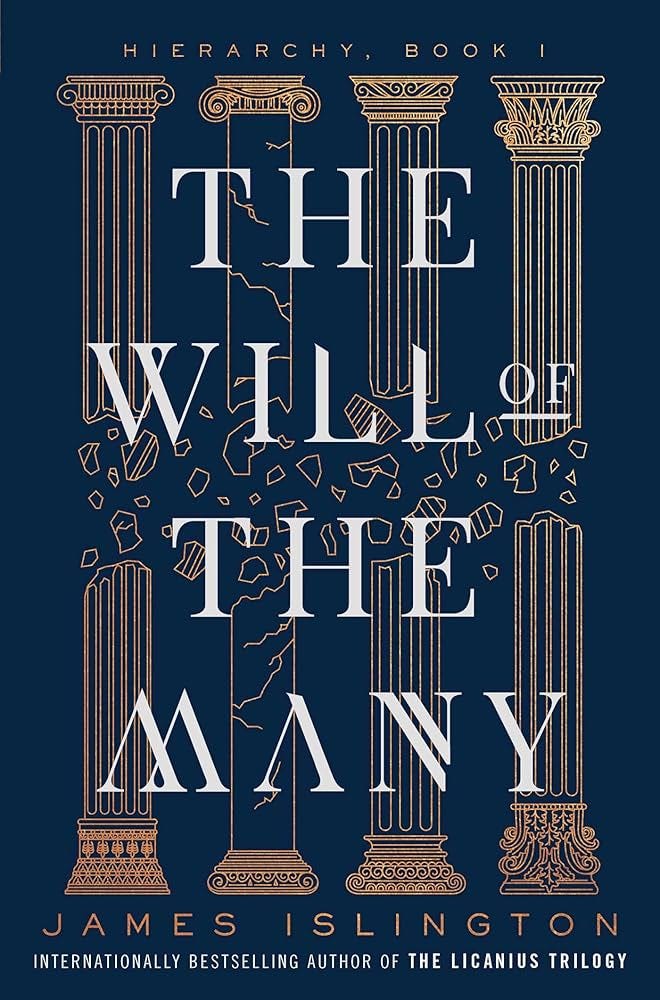
Okay, fantasy fanatics, buckle up! I just blasted through James Islington’s The Will of the Many , the first book in the Hierarchy series, and WHOA. Just… whoa. Islington delivered with the Licanius Trilogy, but this? This is a whole new level of awesome, blending Roman-esque vibes, a killer magic system, and a twisty plot that kept me guessing. As your resident fantasy geek blogger, I have to break this down for you guys. Get comfy, grab a snack, maybe some caffeine, ‘cause we’re diving deep – and yes, MAJOR SPOILERS AHEAD! You’ve been warned!
Plot Synopsis: Hold Onto Your Togas!
Alright, let’s unravel this beast. The story follows Vis, our protagonist, who we first meet living a pretty grim life under the thumb of the Catenan Hierarchy. This isn’t your standard empire; their whole society, their power , runs on something called Will. Think life force, energy, drive – citizens called Octavii cede a portion of their Will up the ranks, empowering those above them (Septimii, Sextii, Quintii, etc., all the way up to the Princeps). It’s a system built on, let’s be real, mass sacrifice, and it’s got a very Roman, very structured, very brutal feel.
Meet Vis (Not His Real Name!):
We initially see Vis working as a prison guard assistant in Letens, a remote Catenan province. He’s keeping his head down, haunted by a traumatic past event where his family was killed and he barely escaped. He’s got secrets darker than a dungeon at midnight.
The Inciting Incident:
Things kick off when a high-ranking official, Sextus Hospius (who turns out to be Senator Ulciscor Telimus in disguise), arrives with special clearance to interrogate a prisoner named Nateo in the deep cells, where prisoners are hooked up to “Sappers” – devices that drain all their Will, leaving them husks. During the interrogation (conducted in the ancient Vetusian language, which Vis shouldn’t understand but does), Vis accidentally touches a Sapper… and nothing happens. This is HUGE because Sappers are supposed to instantly drain anyone. Ulciscor notices. Uh-oh.
The Theatre & The Setup:
To keep Vis close (and maybe test him?), Ulciscor arranges for Vis to get “banished” from his prison job after a staged incident (a brutal fight against a Sextus in an underground fight club called the Theatre, where Vis proves he’s way more skilled than he lets on). Vis ends up in a Catenan orphanage run by the truly nasty Matron Atrox.
The Offer & The Academy:
Ulciscor formally adopts Vis (now Vis Telimus), revealing his true identity and offering him a chance to attend the prestigious Catenan Academy on the isolated island of Solivagus. The catch? Ulciscor suspects something fishy is going on at the Academy, connected to the death of his younger brother, Caeror, years ago during the Academy’s final test, the Iudicium. He needs Vis to be his eyes and ears.
Academy Life - Friends & Frenemies:
Vis arrives at the Academy, starting at the bottom in Class Seven. The Academy is a pressure cooker, strictly hierarchical, where Will use is forbidden to level the playing field. He quickly makes friends with the sharp, disillusioned Callidus Ericius (son of the Censor, a very powerful figure) and the stoic, Cymrian warrior Eidhin Breac. He also clashes with bullies and navigates complex social dynamics, meeting key figures like the competitive Belli Volenis, the enigmatic Emissa Corenius, the suspicious Iro Decimus, and the seemingly friendly Aequa Claudius.
Political Intrigue:
Callidus reveals the immense political tension within the Hierarchy – Military vs. Governance vs. Religion – and the potentially catastrophic consequences of the Republic having run out of places to conquer, making the Military’s dominance precarious. He explains his own presence in Class Seven is a calculated move to protect his father by reducing his own value as a political hostage.
The Naumachia Attack:
A planned trip to Caten for the Festival of Jovan turns into a nightmare. During a massive naval battle reenactment (the naumachia), Estevan (a former advisor from Vis’s past, now revealed as Melior, leader of the rebellious Anguis group) launches a devastating attack, using an unknown power to slaughter thousands of spectators and disable Will use in the Arena. Vis barely escapes the carnage, guided by Aequa through the sewers. He also encounters Sedotia, an Anguis agent who orchestrated his meeting with Ulciscor and now demands his loyalty, threatening exposure if he refuses.
Return to Suus:
Vis is invited by Indol Quiscil (son of the Military Dimidius) to join him and other Military-aligned students (Emissa, Belli) for training during the trimester break… on the island of Suus, Vis’s conquered homeland. It’s an emotional and painful return. He sees the Catenan overlay on his culture, the despoilment of the palace. He also encounters Fadrique, a former advisor who stayed and became a Catenan Sextus, ostensibly to help his people. Fadrique confirms Vis’s family was hanged and reveals he hid precious family heirlooms for Vis.
The Ruins & The Dome:
Back at the Academy, Vis is driven by Ulciscor’s need for answers about Caeror and the potential weapon Religion might be seeking. Following Ulciscor’s intel (and suspecting a connection to his own hazy memories), Vis undertakes a dangerous solo night expedition beyond the Academy walls to investigate ruins. He discovers a hidden, ancient facility.
The Labyrinth:
Inside, he finds schematics matching the Labyrinth training device at the Academy and Villa Telimus.
The Crypt:
Deeper in, he finds a horrifying crypt filled with hundreds of impaled, eyeless corpses preserved by green light, clutching obsidian blades.
The Map Room:
He activates a chamber displaying three glowing topographical maps – one of present-day Solivagus, one of Solivagus with a town cleared in the forest, and one showing Solivagus utterly devastated with a crater and a hovering sphere.
The Voices:
He hears disembodied voices chanting in Vetusian, “Obiteum is lost. Do not open the gate. Synchronous is death.”
The Guardians:
He meets ancient, eyeless guardians (Artemius Sel, Elia Veranius) condemned to servitude, who explain the place is a test of “basic proficiency” to reach “Obiteum and Luceum” via a “gate,” guarded by “Remnants.” He witnesses Artemius destroyed by these Remnants (shrieking shards of black glass). He also receives mysterious Vetusian words etched onto his skin (WAIT, then RUN).
The Iudicium & The Setup:
The final test, the Iudicium, is announced early. The goal: retrieve the “Heart of Jovan” (a Will-imbued artifact) guarded by Sextii from somewhere on the island and return it. Thirds choose Fourth year partners. The rules allow Fourths to switch allegiance or even steal a Third’s medallion to win themselves. Vis chooses Callidus and Eidhin. Veridius reveals there have been suspicious student deaths/disappearances connected to the Iudicium for years. Callidus shows Vis stolen documents confirming this.
The Betrayal & The Confrontation:
During the Iudicium, Vis’s team is ambushed. Sianus is killed by Anguis posing as the safety team. Callidus is gravely wounded. Vis realizes the Anguis knew their location. Tracking leads him to Aequa and Marcellus (another Fourth). Aequa reveals Emissa, Valentina, and Tem are making a play for the Heart, using Prav (another Third) and Titus (a Fourth) as bait. Aequa’s plan to use Vis’s tracker (swallowed earlier for “safety”) as a decoy fails when the Anguis arrive – they planted the tracker on Iro’s broth! The Anguis kill the safety team members.
The Red Dome & Caeror:
Driven by a strange pulse, Vis tracks the Anguis to the other ruins Ulciscor mentioned. He enters the blood-red dome and descends into a chamber identical to the one Artemius Sel guarded. He finds Caeror Telimus alive, who reveals Vis is a copy created by the dome mechanism (Obiteum? Luceum?), connected to his original self back in “Res” (reality?). Caeror explains they have minutes to send a message back before the connection fades. He gives Vis a knife.
The Ending:
Vis wakes back in the infirmary, arm gone (“rot”). Veridius reveals the truth: the dome is Obiteum, the writing on Vis’s arm a message from Caeror. The Hierarchy knows about this place; they test/use students. Veridius needs Vis’s help to stop the next Cataclysm. Eidhin reveals he was in a Sapper for killing Praetorians who attacked his tribe. The book ends with Vis discovering a carved wooden toy ship from his childhood, left mysteriously by his bed, inscribed with his true name : Diago. Chills!
Character Analysis: More Layers Than an Onion Toga
Islington populates this world with characters that feel real, flawed, and compelling.
Vis (Diago):
Our boy! Scarred (literally and figuratively) by his past, Vis is driven by survival. He’s intelligent, adaptable, a surprisingly skilled fighter (thanks, Theatre!), and deeply cynical about the Hierarchy. His core conflict is maintaining his hidden identity while navigating a system he despises, complicated by Ulciscor’s demands and the ghosts of his past. His discovery that he might be a copy throws everything into chaos. His loyalty to his few friends (Callidus, Eidhin, Emissa) is a key strength and potential weakness.
Ulciscor Telimus:
The manipulative Magnus Quintus. Is he a mentor or a master puppeteer? His grief over Caeror is palpable, driving his quest for answers and potentially blinding him. He sees Vis as a tool, but there are hints of genuine, albeit conditional, affection. His secrets run deep.
Lanistia Scipio:
The badass blind tutor. Intense, demanding, and initially cold, she reveals layers of past trauma connected to the Academy and Caeror. Her “sight” via Will is fascinating and terrifyingly effective. Her relationship with Vis thaws slightly, built on grudging respect. Don’t mess with Lanistia.
Callidus Ericius:
Probably my favourite secondary character. Witty, politically savvy, but burdened by his father’s expectations and the secret knowledge of the Academy’s dangers. His friendship with Vis feels genuine and provides much-needed warmth and exposition. His decision to drop ranks is a massive statement about his priorities.
Emissa Corenius:
Vivacious, skilled, and initially seeming like a straightforward friend and potential love interest. Her actions during the Iudicium, however, reveal a ruthless ambition and capacity for betrayal that is shocking and heartbreaking. Was she playing Vis all along?
Eidhin Breac:
The strong, silent type. His Cymrian heritage and hidden past (killing Praetorians, surviving a Sapper!) add intriguing depth. His loyalty is hard-won but fierce. His quiet covering for Vis in the dorm shows unexpected integrity.
Supporting Cast:
Veridius Julii (the charming, possibly sinister Principalis), Aequa Claudius (driven, potentially underestimated), Belli Volenis (arrogant, skilled but flawed), Iro Decimus (classic antagonist), Relucia/Sedotia (master manipulator), Estevan/Melior (tragic rebel leader) – they all add significant texture and drive the plot in crucial ways.
Thematic Resonance: Power Corrupts, Secrets Kill
Islington isn’t just telling a cool story; he’s digging into some heavy themes.
Hierarchy & Power:
The entire Catenan system is built on a literal pyramid of power derived from the Will of the masses. The book constantly questions the morality of this – the cost to the Octavii, the inherent inequality, the way it breeds corruption and ambition.
Sacrifice & Cost:
What are people willing to give up for power, safety, or principle? Octavii sacrifice their life force, Vis sacrifices his identity, Callidus sacrifices his rank, Estevan sacrifices everything for rebellion. The Will system itself is predicated on sacrifice.
Truth, Secrets & Identity:
Vis’s life is a lie. Ulciscor has secrets. Lanistia has secrets. The Academy has secrets. The ruins hold ancient secrets. The search for truth (about Caeror, about the Hierarchy, about Vis himself) is a major engine of the plot. The final reveal about Vis potentially being a copy is the ultimate identity crisis.
The Weight of History:
The past constantly haunts the present – the Cataclysm, the invasion of Suus, Caeror’s death, the ancient ruins. Characters are shaped and burdened by historical events and personal traumas.
Loyalty vs. Ambition:
Where do characters’ loyalties lie? To family, faction, friends, ideals, or themselves? This plays out dramatically, especially during the Iudicium.
World-Building Deep Dive: Rome Meets Magic School
The world Islington crafts is detailed, immersive, and feels lived-in.
The Catenan Hierarchy:
This is the core. A rigidly structured, Roman-inspired society. Power flows upward through ranks (Octavus, Septimus, Sextus, Quintus, Quartus, Tertius, Dimidius, Princeps) defined by the amount of Will they command. The three senatorial pyramids (Military, Governance, Religion) add another layer of political complexity.
The Will System (Peliphagy):
The magic system is unique and central. It’s not just about raw power; it’s about control, precision, and understanding different applications (Direct, Relational - Harmonic/Reactive, Conditional). Will can be ceded, imbued into objects, used for physical enhancement, and tragically drained by Sappers. The Aurora Columnae are ancient devices essential for the initial ceding process.️
The Academy:
Located on the isolated, wild island of Solivagus. A place of intense pressure, political maneuvering, and dangerous secrets. The class system mirrors the Hierarchy, and the Iudicium is the ultimate test. It’s not Hogwarts, folks. Think more brutalist military academy with ancient mysteries.
History & Mystery:
The pre-Cataclysm era looms large. The ruins Vis explores hint at lost technologies, different applications of Will, and possibly the cause of the Cataclysm itself. Obiteum, Luceum, Res, the Remnants – these are tantalizing pieces of a much larger puzzle.
Locations:
From the grim prison of Letens to the overwhelming scale of Caten, the nostalgic beauty of Suus (even conquered), and the wild danger of Solivagus, the settings feel distinct and impact the characters’ experiences.
Genre Context & Comparisons: Familiar Flavors, Unique Blend
The Will of the Many sits comfortably in the epic fantasy camp but pulls in elements from other subgenres.
Roman-Inspired Fantasy:
The Catenan aesthetic, political structure, military focus, and naming conventions scream Roman Empire. It shares DNA with series like Jim Butcher’s Codex Alera or aspects of Stover’s Acts of Caine , but with a unique magical twist.
Magic School:
The Academy setting obviously invites comparisons to Harry Potter , Name of the Wind , or The Magicians. However, Islington’s take is much darker, more politically charged, and less focused on whimsical discovery than on brutal competition and survival.
Progression/Cultivation Hints?:
While not a strict example, Vis’s need to rapidly improve his skills (Labyrinth, understanding Will, political maneuvering) to survive and advance touches on themes seen in progression fantasy like Iron Prince or Cradle.
Comparison to Licanius:
Fans of Islington’s previous work will recognize the intricate plotting, the slow burn reveals, the complex world-building with historical depth, and the focus on characters burdened by secrets and destiny. Hierarchy feels perhaps grittier and more politically focused so far.
Tropes:
It uses the “orphan protagonist with a secret past,” the “mentor with hidden motives,” and the “brutal magic school” tropes but executes them with a fresh perspective and relentless pacing. The Will system feels original and deeply integrated.
Influences & Inspirations: Echoes of Empire and Ideas
While Islington hasn’t explicitly stated all his influences, some potential ones seem clear:
The Roman Empire:
Undeniably the biggest influence on the Catenan Hierarchy’s structure, military focus, naming, and aesthetics. The idea of an empire built on the literal life force of its populace is a dark twist on historical exploitation.
Utilitarianism vs. Individual Rights:
The entire Will system poses a philosophical question: does the “greater good” (the power and stability of the Hierarchy) justify the sacrifice of the individual (the Octavii)? Estevan’s/Melior’s speeches directly challenge this.
Classic Epic Fantasy:
The scope, the detailed world-building, the focus on power struggles, and a protagonist caught in events larger than himself all echo traditions within epic fantasy.
Mystery/Thriller Pacing:
The way secrets are layered and revealed, the constant sense of danger and political maneuvering, gives the book a thriller-like pace at times.
Key Takeaways:
- The Catenan Hierarchy runs on “Will,” a life-force magic system creating a rigid, Roman-esque society built on mass sacrifice.
- Vis (Diago) is a survivor with a hidden royal past, whose unique interaction (or lack thereof) with Will-draining Sappers makes him a person of interest.
- The Academy on Solivagus is a deadly political game masquerading as education, harboring ancient and dangerous secrets.
- Power, sacrifice, identity, and the weight of history are central themes explored through a twisty, engaging plot.
- Ancient mysteries (pre-Cataclysm tech, Obiteum, Luceum, Remnants) and present-day political conspiracies (Military vs. Religion, the Anguis) are deeply intertwined.
- Friendship and loyalty are tested against brutal ambition and systemic corruption.
- The ending reveal – Vis being a copy and meeting the real Caeror – fundamentally changes the stakes and nature of the story.
Wrapping It Up
Guys, seriously, The Will of the Many is phenomenal. It takes the intricate plotting and world-building Islington is known for and injects it with relentless pacing, brutal political intrigue, and a fascinating magic system that has massive societal implications. Vis is a fantastic protagonist – resourceful, cynical, but with a core of integrity fighting to survive. The supporting cast is complex, the mysteries are deep, and that ending?! It’s a masterclass in setting up a series. If you love Roman-inspired settings, intricate magic systems, dark academia vibes, and plots that make your brain hurt (in the best way!), you NEED to pick this up. Islington has absolutely cemented himself as a must-read author in modern fantasy. Go read it! You won’t regret it!